As Amazon Associates, we earn from qualifying purchases. This means we may receive a small commission at no extra cost to you if you click through and make a purchase.
Finding the right polaroid with film setup can transform how you document creative workflows, organize pinboards, and capture quick reference shots around a studio or home office. Instant analog cameras offer an immediate, tangible record of projects and daily milestones that digital files simply cannot replicate on a screen. Purchasing a complete starter kit that packages the camera hardware directly with matching color chemistry eliminates the guesswork of compatibility, letting you set up your shot framing, test lighting conditions, and display prints on your desk immediately.
This comparison covers three specific kits: the full-sized Polaroid Now 3rd Generation I-Type Instant and two compact alternatives, the Polaroid Go Generation 2 and the Polaroid Go Generation 3 Bundle. While every bundle includes analog hardware paired with 16 color photos, they serve noticeably different desk setups and creative routines. The primary difference lies in print geometry and camera scale, separating iconic full-format prints engineered for studio wall boards from pocket-sized film sheets suited for compact organizers, monitor edges, and mobile field notes.
Which Polaroid Instant Cameras Should You Buy
- For classic full-sized prints, studio tripod mounting, and twin-lens autofocusing: Polaroid Now 3rd Generation I-Type Instant
- For ultra-compact desk storage, wearable everyday carry, and pocket-sized photo documentation: Polaroid Go Generation 2
- For upgraded flash output, closer framing, and enhanced miniature portraits: Polaroid Go Generation 3 Bundle
01 Polaroid Now 3rd Generation I-Type Instant
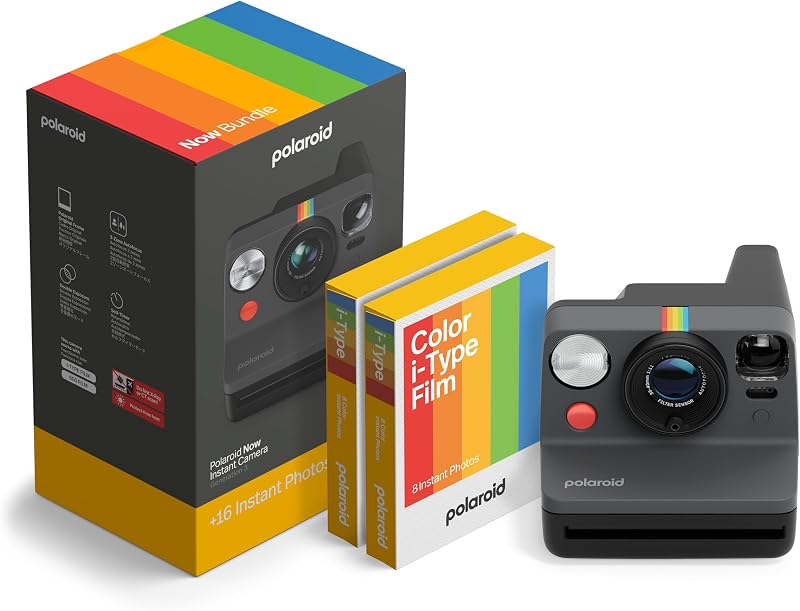
Best for: Studio boards and full-sized analog displays
Pros
- Twin-lens autofocus system
- Shoots i-Type and 600 film
- Built-in tripod mount
- USB-C rechargeable battery
Cons
- Larger physical body footprint
The Polaroid Now 3rd Generation I-Type Instant camera is designed for creators who demand classic square-format prints for visual boards, portfolios, and desk displays. As a traditional large polaroid camera format option, it produces full-sized physical photos on either battery-free i-Type film or vintage 600 film packs. The included bundle supplies the black camera body alongside 16 color photos, giving you two full eight-exposure cartridges right away. Because the camera uses an internal USB-C rechargeable battery rated to power through more than 15 film packs, you do not need to rely on disposable single-use batteries to keep your photographic workflow moving.
In a daily workspace routine, this third-generation model stands out through its updated optical and sensor layout. The camera features an upgraded light meter position, an improved ranging sensor, and an automated two-lens autofocus system. Rather than forcing you to estimate focal distances manually when snapping desk vignettes or portrait subjects, the camera selects the optimal lens automatically. It also integrates a built-in tripod mount on the base plate, allowing you to anchor the camera for self-timer team portraits or precise double-exposure creative experiments without camera shake.
This model is the ideal choice for dedicated craft rooms, design studios, and home offices where physical display space on pegboards or ledgers is abundant. Its physical size is larger than mini alternatives, which makes it less suited for sliding into a small jacket pocket, but that larger footprint rewards you with expansive image real estate and direct filter compatibility for stylized analog shooting.
- Dual-lens autofocusing system that switches between close-up and standard distance lenses automatically
- Native compatibility with both modern Polaroid i-Type film and vintage 600 film stocks
- Built-in tripod mount, optical viewfinder, and USB-C rechargeable internal battery lasting over 15 packs
- Creative shooting controls including dedicated double-exposure and self-timer modes
02 Polaroid Go Generation 2
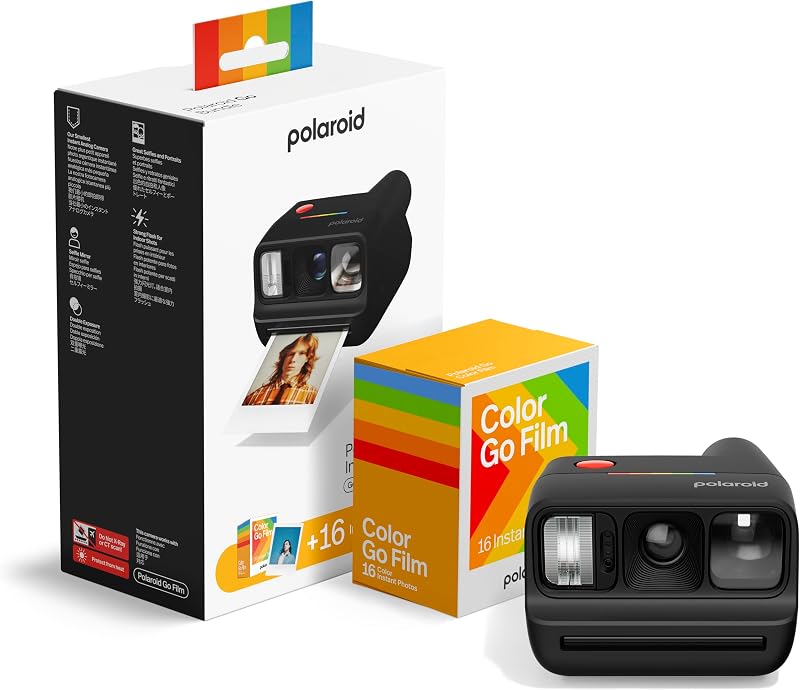
Best for: Indoor workspace portraits and mini prints
Pros
- Stronger built-in flash
- Fresh lens reduces glare
- Includes 16 color photos
- Convenient pocket-sized form factor
Cons
- Incompatible with i-Type film

Best for: Everyday desk carry and compact planning
Pros
- Pocketable ultra-compact frame
- Reflective selfie mirror viewfinder
- Shoots 15 packs per charge
- Made with 30 percent recycled materials
Cons
- Limited to miniature Go film
The Polaroid Go Generation 2 represents the brand’s push into ultra-compact analog documentation. Packaged as a mini instant camera bundle with 16 photos included, this model shrinks the physical camera body down to an ultra-portable profile constructed with 30 percent recycled materials. It shoots exclusively on miniature Polaroid Go film, creating scaled-down prints that fit neatly into wallet sleeves, phone cases, and the borders of desktop planners. For individuals exploring diverse polaroid instant cameras for tight work environments, this miniature footprint leaves plenty of room on shallow desks.
Despite its small size, the Generation 2 model integrates upgraded exposure hardware over original mini designs. It features a wide aperture range, an accurate ambient light sensor, and an automated exposure management system that balances highlights and shadows more reliably. The front of the camera features a reflective viewfinder that doubles as a built-in selfie mirror, making single-handed framing straightforward during collaborative office moments or solo creative journaling. Like its larger sibling, the Generation 2 runs on a built-in USB-C rechargeable cell capable of shooting up to 15 film packs per charge cycle.
This camera fits users who need an unobtrusive photographic tool that lives next to a keyboard or travels in an everyday commuter bag. Because the film format is restricted strictly to Polaroid Go cartridges, it yields smaller prints than full-size i-Type frames. However, for rapid visual note-taking, cataloging physical material swatches, or keeping spontaneous mementos in compact desktop trays, the space efficiency is tough to beat.
- Ultra-compact, wearable housing made with 30 percent recycled materials for everyday portability
- Upgraded aperture range and refined light sensor for balanced automatic exposure control
- Reflective viewfinder selfie mirror paired with double-exposure and self-timer options
- Internal USB-C rechargeable battery delivering up to 15 film packs of operating life
03 Polaroid Go Generation 3 Bundle
The Polaroid Go Generation 3 Bundle builds on the ultra-portable Go concept by introducing refined optical and illumination components. Supplied with 16 color photos in the package, this kit delivers everything required to produce immediate miniature prints that slide directly into phone cases and personal notebooks. The Gen 3 hardware is engineered around a fresh lens configuration and a more powerful built-in flash, directly addressing the challenge of indoor ambient lighting in home offices and windowless creative studios.
Capturing clear polaroid camera color photos in indoor workspace conditions often hinges on flash output, and the Gen 3 addresses this with punchier illumination that prevents muddy shadows. The optical redesign also reduces glare during close-up portraiture, helping your facial features stay sharp and properly exposed when using the front selfie mirror. The unit maintains the standard Go feature set, including one-touch self-timer functions and multi-frame double exposures, while keeping the overall dimensions down to 4.61 by 2.83 by 6.77 inches.
This third-generation mini bundle is tailored for professionals and hobbyists who frequently take photos in mixed indoor lighting or need a dedicated camera for events, desk vignettes, and team check-ins. If your workspace lacks consistent daylight, the stronger flash on this model offers a distinct operational advantage over earlier iterations, though it remains tied exclusively to the miniature Polaroid Go film format.
- Upgraded optical lens assembly paired with a more powerful built-in flash for improved indoor clarity
- Front-facing selfie mirror engineered for centered framing with reduced glare
- Convenient pocket-sized dimensions measuring 4.61 by 2.83 by 6.77 inches
- Full creative versatility with integrated self-timer and double-exposure shooting modes
What Sets These Models Apart
Choosing between these Polaroid kits comes down to balancing film display dimensions, optical automation, and physical portability across your workspace. The table below outlines how each camera handles film formats, shutter speeds, and core hardware features.
| Model | Film Format Compatibility | Shutter Speed Range | Primary Distinguishing Feature |
|---|---|---|---|
| Polaroid Now 3rd Generation I-Type Instant | Polaroid i-Type and Polaroid 600 | Maximum 1/60 seconds | Twin-lens autofocus system and tripod mount |
| Polaroid Go Generation 2 | Polaroid Go film only | 1/300 to 1 seconds | Ultra-compact body with 30% recycled materials |
| Polaroid Go Generation 3 Bundle | Polaroid Go film only | Automatic exposure control | Fresh lens design with stronger built-in flash |
Buying Tips for Polaroid Instant Cameras
When selecting an instant camera bundle for your workspace, start by assessing how you plan to store and display your finished prints. Full-sized i-Type and 600 prints offer expansive detail and classic white borders that stand out on cork boards, magnetic wall rails, and framed photo ledgers. In contrast, Polaroid Go prints produce miniature, business-card-scale physical media that slip effortlessly into daily planners, clear phone cases, or minimal desktop card holders without causing visual clutter on smaller workstations.
Lighting conditions in your workspace also dictate which model will deliver the most consistent results. Instant analog film requires significant ambient light to develop vibrant contrast and sharp edges. The Polaroid Now 3rd Generation relies on its twin-lens autofocus and an upgraded ranging sensor to maximize daylight and studio lamps, while also offering a tripod mount for steady low-light compositions. If you work primarily in dim rooms or rely on evening desk lamps, the stronger flash system found on the Polaroid Go Generation 3 provides crucial illumination to prevent underexposed, muddy frames.
Finally, consider how the camera fits into your charging and hardware maintenance routines. All three models featured here utilize built-in rechargeable batteries powered via USB-C, ditching the need for disposable AA or AAA cells. Connecting your camera to a standard USB-C desk hub keeps it topped off and ready for spontaneous brainstorming sessions. Remember that film cartridges must be stored flat in a cool, dry environment away from direct heat to preserve the chemical pods before exposure.
FAQ
Can you shoot i-Type film in a Polaroid Go camera
No, Polaroid Go cameras are only compatible with miniature Polaroid Go film cartridges. The camera body and film ejection slot are physically too small to accept full-sized i-Type or vintage 600 film packs. If you want to shoot classic full-format prints, choose the Polaroid Now 3rd Generation.
How many shots come with each polaroid with film bundle
Each of the three bundles featured in this guide includes a total of 16 color photos. For the Polaroid Now 3rd Generation, this consists of two 8-exposure packs of full-sized i-Type film. For the Polaroid Go Generation 2 and Generation 3, the kits provide two 8-exposure packs of miniature Polaroid Go film.
How does the autofocus system work on the Polaroid Now 3rd Generation
The Polaroid Now 3rd Generation uses a two-lens autofocusing system paired with an upgraded ranging sensor. The camera automatically determines the distance to your subject and selects between a close-up lens and a standard distance lens without requiring manual adjustment on the barrel.
Why does shutter speed matter for workspace instant photography
Shutter speed controls how long the camera sensor and film emulsion are exposed to light. Fast shutter speeds help freeze subject movement and prevent blur from hand tremors, while slower shutter speeds allow more ambient indoor light onto the frame. Cameras with wide shutter ranges or automated exposure controls help balance ambient office lighting with flash output.
What is the benefit of USB-C recharging in these instant cameras
Integrated USB-C recharging eliminates the recurring expense and environmental waste of disposable alkaline batteries. A single charge on these cameras powers through up to 15 film packs, allowing you to easily top up the battery using standard workspace charging cables and computer docks.