As Amazon Associates, we earn from qualifying purchases. This means we may receive a small commission at no extra cost to you if you click through and make a purchase.
Finding the right cooler master pc requires looking beyond raw component specifications to understand how a desktop tower interacts with your everyday workstation. High-performance computing introduces substantial thermal loads, variable acoustic profiles, and physical clearance considerations that directly shape your daily focus and room comfort. Cooler Master approaches these engineering challenges from its heritage in thermal management, combining specialized chassis designs, high-throughput ventilation, and clean interior layouts to maintain consistent operation during extended work sessions and demanding graphical tasks.
This cooler master pc comparison examines three high-end prebuilt desktop towers to help you determine which cooler master pc to buy for your personal desk setup. We examine the cooler master haf 5 pro alongside two variations of the cooler master td5 pro to see how air cooling compares with liquid cooling, how AMD and Intel platforms handle heavy workloads, and how each tower balances acoustic performance with physical footprint across dedicated gaming, creative production, and day-to-day office routines.
Which Cooler Master Desktop PCs Should You Buy
- Cooler Master HAF 5 Pro Gaming: Select this build if you want high-airflow air cooling, a dedicated peripheral bundle, and the gaming-proven AMD Ryzen 7 7800X3D matched with GeForce RTX 5070 graphics for 1440p gaming and balanced productivity.
- Cooler Master TD5 Pro Gaming PC (Ryzen 7 9800X3D): Choose this cooler master rtx 5080 pc if your priority is top-tier gaming frame rates supported by liquid cooling, AMD’s next-generation 9800X3D architecture, and quiet thermal management in the TD500 Mesh enclosure.
- Cooler Master TD5 Pro Gaming PC (Intel Ultra 7 265F): Pick this 20-core cooler master desktop pc if your daily routine centers on video editing, heavy multitasking, and computational rendering alongside 4K gaming, backed by liquid cooling and 16GB of video memory.
01 Cooler Master HAF 5 Pro Gaming

Best for: Airflow enthusiasts and balanced 1440p gaming
Pros
- Dual 200mm front ARGB fans
- Ryzen 7 7800X3D processor
- Includes keyboard and mouse bundle
- Generous 2TB Gen4 SSD
Cons
- Lower wattage 650W power supply
- Bulkier chassis footprint
The Cooler Master HAF 5 Pro Gaming is built inside the HAF 500 ARGB mid-tower chassis, a case purpose-engineered around massive airflow. The prominent design feature of this build is its dual 200mm front ARGB intake fans, which rotate at lower speeds than traditional 120mm fans while pushing a substantial volume of air directly across the main chamber. Paired with Cooler Master’s Hyper 212 Halo ARGB air cooler, the internal thermal architecture keeps ambient temperatures controlled without requiring liquid plumbing. For users placing their desktop on or beside a desk, the larger front fans deliver a steady acoustic hum that blends into ambient office noise better than the higher-pitched whine common to smaller, high-RPM cooling fans.
Under the tempered glass side panel, this cooler master gaming desktop features the AMD Ryzen 7 7800X3D processor mounted to a Gigabyte B650 motherboard. The 8-core, 16-thread CPU operates with a 4.2GHz base clock and up to 5.0GHz turbo frequency, relying on AMD’s 3D V-Cache architecture to accelerate complex gaming physics, simulation calculations, and general compute routines. Graphics processing is handled by NVIDIA’s GeForce RTX 5070 (the listing highlights 16GB in its bullet features and 12GB in its technical specification summary). This hardware combination comfortably targets high-refresh 1440p gaming and rapid content manipulation. In contrast to modest legacy hardware like a cyberpowerpc gtx 1050ti, this modern rig delivers modern architectural efficiency, real-time ray tracing support, and rapid Gen4 NVMe responsiveness.
Memory and storage configurations include 32GB (2x16GB) of DDR5 6000MHz RGB RAM equipped with dedicated heatsinks, alongside a 2TB Gen4 M.2 SSD driven by a Gen 4×4 NVMe controller. Connectivity on the chassis and rear I/O panel includes one standard Type-C port, two USB 3.2 Gen 2 Type-C ports, six traditional USB ports, dual DisplayPort outputs, and one HDMI port. Networking is managed through onboard WiFi supporting 802.11 ac/b/g/n protocols and Bluetooth. Measuring 20.3 by 8.82 by 20.1 inches and weighing 31 pounds, the HAF 5 Pro requires adequate desk depth or dedicated floor clearance. It also ships with a Devastator 3 RGB keyboard and mouse combination, Windows 11 Home, and an installation free of third-party bloatware, powered by a 650-watt 80 Plus Gold power supply.
- Dual 200mm ARGB front intake fans paired with a Hyper 212 Halo ARGB air cooler for sustained airflow
- AMD Ryzen 7 7800X3D 8-core processor coupled with a GeForce RTX 5070 graphics card
- High-speed 2TB Gen4 M.2 NVMe SSD and 32GB DDR5 6000MHz RGB dual-channel memory
- Includes Devastator 3 RGB keyboard and mouse set with a clean Windows 11 Home operating system
02 Cooler Master TD5 Pro Gaming PC
Best for: Video editors and heavy multi-threaded creators
Pros
- Intel Ultra 7 20-core CPU
- GeForce RTX 5080 16GB graphics
- Gigabyte B860 WIFI6E motherboard
- 360L liquid cooling loop
Cons
- Heaviest unit at 38 pounds
- Peripherals not specified in listing

Best for: Enthusiast gamers seeking top-tier 1440p frame rates
Pros
- AMD Ryzen 7 9800X3D CPU
- GeForce RTX 5080 16GB graphics
- 360L liquid cooling radiator
- 850W Gold efficiency PSU
Cons
- Peripherals not specified in listing
- System weight not specified
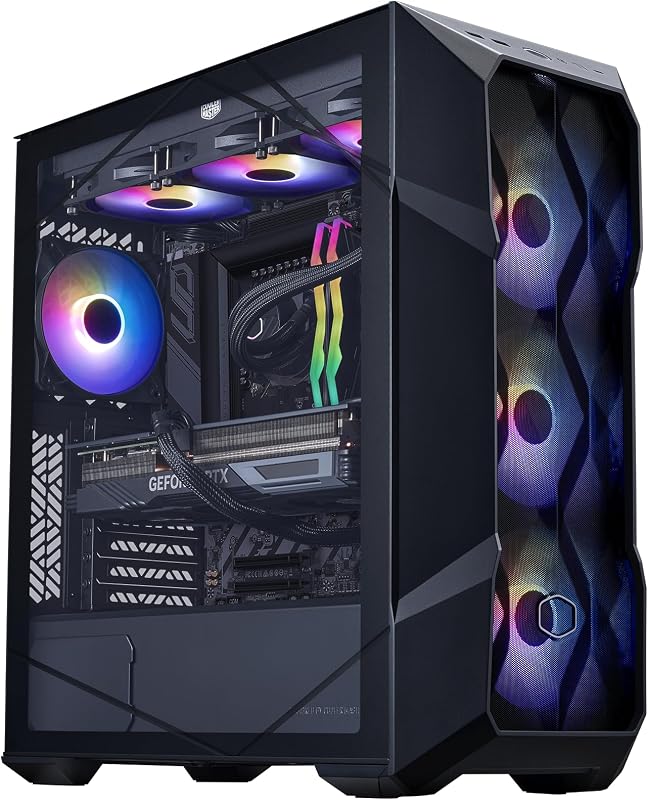
The Cooler Master TD5 Pro Gaming PC steps into premier enthusiast territory by integrating AMD’s Ryzen 7 9800X3D processor with a GeForce RTX 5080 16GB graphics card. Housed within the TD500 Mesh ARGB case, this desktop trades the oversized air fans of the HAF line for an intricately contoured, fine mesh polygonal front panel. This mesh panel optimizes fresh air intake while functioning as a natural dust barrier for your home office environment. A crystalline tempered glass side panel provides visibility into the tidy interior, which is plumbed with a 360L Cooler liquid cooler. By utilizing a 360mm radiator across the top of the chassis, this system disperses processor heat outward quickly, keeping CPU core thermals stable under heavy, sustained compute sessions.
The core computational engine centers around the 8-core, 16-thread Ryzen 7 9800X3D, featuring a 4.7GHz base clock speed and boost capabilities reaching 5.2GHz on a Gigabyte B850 Gaming WF6 motherboard. When paired with the 16GB frame buffer of the GeForce RTX 5080, this build is built to deliver smooth 120+ FPS performance at 1440p on maximum settings, as well as dependable performance in demanding 4K rendering and spatial workloads. The integration of closed-loop liquid hardware functions similarly to premium aftermarket cooling systems detailed in our asus aio 360mm coverage, mitigating sharp fan-ramp spikes during sudden processing bursts to preserve a quieter workspace.
System memory matches the modern high-bandwidth standard with 32GB (2x16GB) of DDR5 6000MHz RGB RAM, while internal storage provides 2TB of Gen4 M.2 NVMe solid-state capacity. Power distribution is handled by an upgraded Cooler Master MWE Gold 850 V3 80 Plus Gold efficiency power supply, giving the high-wattage graphics card and pump motor clean electrical overhead. Physical case dimensions measure 19.7 by 8.3 by 19.7 inches, making the TD500 chassis slightly more compact in depth and width than the HAF 500, though the listing does not specify its overall weight. The front and rear arrays offer two USB 3.2 Gen 2 Type-C ports, one standard Type-C port, six USB ports, one HDMI output, two DisplayPorts, and wireless networking over 802.11 ac/b/g/n and Bluetooth under a clean Windows 11 Home install.
- AMD Ryzen 7 9800X3D processor matched with an enthusiast-class GeForce RTX 5080 16GB GPU
- Dedicated 360L Cooler liquid cooling system mounted in a TD500 Mesh high-airflow chassis
- MWE Gold 850 V3 80 Plus Gold power supply ensuring efficient energy delivery under high loads
- Fast 2TB Gen4x4 NVMe storage paired with 32GB DDR5 6000MHz RGB heatsink-equipped RAM
03 Cooler Master TD5 Pro Gaming PC
The Intel-powered variation of the Cooler Master TD5 Pro Gaming PC caters directly to users whose daily computer usage transitions frequently between demanding gaming sessions, video rendering pipelines, and intensive background computing tasks. Built into the same black TD500 Mesh ARGB chassis, this configuration swaps the AMD platform for an Intel Core Ultra 7 265F processor resting on a Gigabyte B860 WIFI6E motherboard. The Ultra 7 processor features a 20-core architecture dividing work across 8 Performance cores (P-cores) and 12 Efficient cores (E-cores) with a base clock of 2.4GHz and turbo frequencies scaling up to 5.3GHz. This hybrid core topology allows background tasks, software encoding, and file indexing to run on efficiency cores while active foreground tasks leverage dedicated high-frequency performance cores.
Graphical execution is powered by the GeForce RTX 5080 16GB, ensuring this configuration matches the rendering capabilities, AI hardware acceleration, and ray-tracing throughput of its AMD counterpart. To tame thermal output from a 20-core processor and high-draw GPU simultaneously, the rig employs the 360L Cooler liquid cooler. Liquid cooling prevents thermal saturation inside the chassis, expelling heat directly out of the enclosure rather than recirculating it over the motherboard surface. Users who prefer desktop-grade power over the portable thermal constraints of a mobile workstation like a gigabyte gaming laptop will appreciate the acoustic headroom and raw compute throughput afforded by this 38-pound desktop platform.
The system features 32GB of dual-channel DDR5 6000MHz RGB memory with integrated heat spreaders and a 2TB Gen4 M.2 NVMe SSD. For stable power delivery during multi-threaded export sessions, Cooler Master supplies its MWE Gold 850 V3 power supply. The physical profile remains 19.7 by 8.3 by 19.7 inches, resting comfortably under standard office desks or on heavy-duty desktop risers capable of supporting its 38-pound weight. Connectivity covers modern workspace standards with dual USB 3.2 Gen 2 Type-C ports, an additional Type-C connection, six USB type-A ports, HDMI, DisplayPort, HD audio, and integrated WiFi 6E functionality on the motherboard without preloaded trialware or clutter.
- Intel Core Ultra 7 265F 20-core hybrid processor (8 P-cores and 12 E-cores) reaching 5.3GHz Turbo
- GeForce RTX 5080 16GB graphics card for demanding creative software and high-frame-rate rendering
- Cooler Master 360L liquid cooling loop paired with an 850W MWE Gold V3 power supply
- Gigabyte B860 WIFI6E motherboard providing advanced high-speed wireless connectivity
What Sets These Models Apart
Choosing between these three systems involves assessing cooling mechanisms, processor architecture, graphics capability, and system weight. The table below highlights the key hardware specifications across each model to help identify the best cooler master pc for your workstation layout.
| Feature | HAF 5 Pro (7800X3D) | TD5 Pro (9800X3D) | TD5 Pro (Ultra 7 265F) |
|---|---|---|---|
| Processor | AMD Ryzen 7 7800X3D (8 cores, up to 5.0GHz) | AMD Ryzen 7 9800X3D (8 cores, up to 5.2GHz) | Intel Core Ultra 7 265F (20 cores, up to 5.3GHz) |
| Graphics Card | GeForce RTX 5070 (12GB/16GB listed) | GeForce RTX 5080 16GB | GeForce RTX 5080 16GB |
| Cooling Solution | Hyper 212 Halo Air Cooler + 200mm Fans | 360L Cooler Liquid Cooler | 360L Cooler Liquid Cooler |
| Power Supply | 650W 80+ Gold | 850W MWE Gold V3 | 850W MWE Gold V3 |
| Motherboard | Gigabyte B650 | Gigabyte B850 Gaming WF6 | Gigabyte B860 WIFI6E |
| Chassis Dimensions & Weight | 20.3 x 8.82 x 20.1 in; 31 lbs | 19.7 x 8.3 x 19.7 in; weight not specified | 19.7 x 8.3 x 19.7 in; 38 lbs |
Buying Tips for Cooler Master Desktop PCs
When selecting a cooler master prebuilt pc, evaluating desk placement and ventilation clearance is your most important initial step. Both the HAF 500 and TD500 Mesh chassis rely heavily on unrestricted front air intake. Placing these towers inside fully enclosed desk cabinets or directly flush against a wall will choke intake fans and compromise the system’s thermal design. Allow at least four to six inches of clear space in front of and behind the chassis to facilitate steady airflow. If positioning the tower on a carpeted floor, consider a firm computer riser to prevent the bottom power supply intake from drawing in floor dust and carpet fibers.
Consider your daily workload profile when deciding between the air-cooled HAF platform and the liquid-cooled TD5 configurations. Air cooling via the Hyper 212 Halo is mechanically simple, highly reliable over years of continuous operation, and avoids the minor pump hum inherent to liquid cooling loops. However, the 360L Cooler liquid system found on the TD5 Pro configurations offers superior thermal buffer capacity. When dealing with sudden spikes in CPU demand during video encoding or physics computations, a 360mm radiator absorbs thermal surges smoothly, keeping fan speeds from ramping up and down abruptly while you work.
Finally, review your peripheral requirements and desk power distribution. The RTX 5080 configurations utilize 850-watt power supplies, which demand clean power delivery, ideally supported by an uninterruptible power supply (UPS) rated for high-wattage computing equipment. Furthermore, while the HAF 5 Pro includes the Devastator 3 keyboard and mouse bundle in the box, the TD5 Pro listings do not specify bundled peripherals. Plan your budget and desk layout accordingly if you need to supply your own mechanical keyboard, precision mouse, and dedicated audio equipment.
FAQ
How loud are Cooler Master prebuilt desktop PCs during everyday desk tasks?
During standard office routines, web browsing, and document editing, all three systems operate with minimal acoustic output. The HAF 5 Pro uses large 200mm front fans that move considerable airflow at low rotational speeds, producing a soft, low-frequency hum. The TD5 Pro configurations use PWM-controlled fans on their 360mm radiators that spin down during light tasks. Under heavy gaming or multi-threaded CPU rendering, the cooling fans will increase in speed, but the open mesh panels reduce air resistance turbulence compared to solid-front cases.
Can I upgrade components inside a Cooler Master prebuilt tower later?
Yes. Cooler Master utilizes standardized ATX cases, retail Gigabyte motherboards (B650, B850, and B860), standard M.2 NVMe storage drives, and standard ATX power supplies. Unlike prebuilt systems that rely on proprietary motherboards or custom power connectors, these systems can be upgraded over time. You can expand storage via open drive slots, add memory, or replace components using standard off-the-shelf retail hardware.
Do these Cooler Master desktop PCs come with preinstalled bloatware?
No. The listings specify that these systems arrive with a clean installation of Windows 11 Home free of third-party bloatware, unwanted trial software, or intrusive background utilities. This ensures that system memory and background CPU cycles remain fully dedicated to your applications right out of the box.
What display connections are available for multi-monitor setups?
All three desktop systems feature one HDMI port and two DisplayPort outputs on their dedicated graphics cards. This layout allows you to connect up to three independent external monitors simultaneously, making these systems well suited for multi-screen trading desks, video editing timelines, and immersive panoramic gaming setups.
What is the primary difference between the two TD5 Pro models?
The primary difference lies in the processor platform and motherboard chipset. The AMD version features the 8-core Ryzen 7 9800X3D on a Gigabyte B850 motherboard, tailored for gaming enthusiasts who prioritize single-thread speed and gaming cache architecture. The Intel version uses the 20-core Intel Core Ultra 7 265F on a Gigabyte B860 WIFI6E motherboard, offering 12 efficiency cores that excel at background rendering, media encoding, and heavily threaded workstation multitasking.