As Amazon Associates, we earn from qualifying purchases. This means we may receive a small commission at no extra cost to you if you click through and make a purchase.
Choosing an instant print polaroid camera for your workspace or daily routine requires balancing the scale of physical photographs against desktop footprint and everyday portability. Analog film prints bring tactile visual documentation to mood boards, project binders, and design journals, turning quick desktop captures into tangible physical artifacts. Modern creators and home office professionals often face a clear decision regarding which polaroid instant camera to buy: whether to prioritize the iconic, full-frame square composition of traditional film or the streamlined convenience of an ultra-compact pocket format that rests unobtrusively beside a keyboard.
This polaroid instant camera comparison examines three specific cameras from the current lineup: the flagship Polaroid Now 3rd Generation I-Type Instant, the pocket-sized white Polaroid Go Generation 2, and the sleek black Polaroid Go Generation 2. While all three options share modern USB-C rechargeable connectivity and creative double-exposure functions, they differ markedly in their optical autofocus arrangements, film sheet dimensions, rolling shutter options, and workspace ergonomics. Evaluating these choices will help you determine how the polaroid i-type vs polaroid go formats integrate into your daily creative rituals. For broader brand contexts, our overview of polaroid instant cameras outlines the historic trajectory of these distinct systems.
Which Polaroid Instant Cameras Should You Buy
- For full-size classic square prints, studio mounting, and automatic focal switching: The Polaroid Now 3rd Generation I-Type Instant delivers traditional square chemical prints and provides a built-in tripod mount for stationary workspace captures.
- For minimalist desks, light-toned aesthetic palettes, and ultra-portable pocket documentation: The white Polaroid Go Generation 2 offers an exceptionally small footprint, an integrated selfie mirror, and high-speed rolling shutter control.
- For dark-themed workspaces, stealth studio gear, and mobile visual logging: The black Polaroid Go Generation 2 provides identical miniature chemical prints and flexible exposure metering in a clean, matte dark housing.
Measure shown: Weight (lb). Every figure is the number the seller publishes on that product page — nothing on this site is measured by us. Longest bar is highlighted.
01 Polaroid Now 3rd Generation I-Type Instant
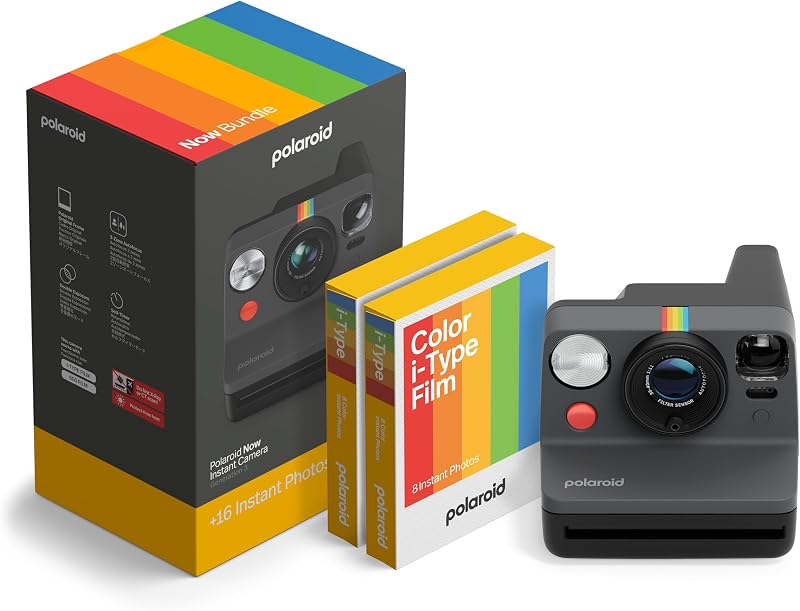
Best for: Studio desks and classic square prints
Pros
- Twin-lens autofocus system
- Built-in tripod mount
- Dual i-Type and 600 film compatibility
- USB-C rechargeable battery
Cons
- Larger footprint on compact desks
- Shutter speed capped at 1/60 seconds
The Polaroid Now 3rd Generation I-Type Instant represents the traditional core of Polaroid analog imaging, retaining the classic heritage silhouette while incorporating meaningful internal upgrades for modern desks. This model produces full-sized physical photographs using battery-free i-Type instant film, while maintaining full compatibility with vintage-style Polaroid 600 film packs. Engineered with an optical viewfinder, automatic exposure control, and housing constructed from future-friendly materials, the camera produces authentic, chemically developed square prints that make a bold statement on studio bulletin boards, wall collages, and desk stands.
In an active home office or creative studio, the camera functions reliably across varied shooting scenarios thanks to its twin-lens autofocusing system. The internal sensor array measures subject distance and automatically determines which lens to engage, switching seamlessly between portrait and landscape zones without requiring manual ring adjustments. This optical capability proves invaluable when documenting three-dimensional mockups, desk organization layouts, or visiting colleagues. Creators seeking the best polaroid camera for desk setup stability will appreciate the built-in tripod mount located on the camera base, enabling secure mounting onto tabletop arms and tripods for fixed-angle documentation or hands-free team portraits using the self-timer.
Power management is streamlined through an integrated USB-C rechargeable battery rated to power through more than 15 individual film packs on a single charging cycle, eliminating the recurring hassle of disposable cells. The camera also supports creative double-exposure modes and photo filter compatibility, enabling rich artistic experimentation directly within the analog frame. While the maximum shutter speed reaches 1/60 seconds, requiring attentive ambient light management, its full-frame presence makes it an exceptional choice for creators who prefer substantial photographic prints over miniature pocket formats.
- Twin-lens autofocus system automatically transitions between focal zones for sharper focus.
- Integrated tripod mount accommodates stationary studio workflows and desk stands.
- Dual compatibility with battery-free i-Type film and vintage-style 600 film packs.
- USB-C rechargeable internal battery rated for over 15 film packs per charge.
02 Polaroid Go Generation 2

Best for: Dark-themed creative setups and mobile documentation
Pros
- Matte black compact chassis
- Integrated reflective selfie mirror
- Creative double-exposure mode
- USB-C rechargeable battery
Cons
- Lacks standard tripod mount
- Limited to miniature film format
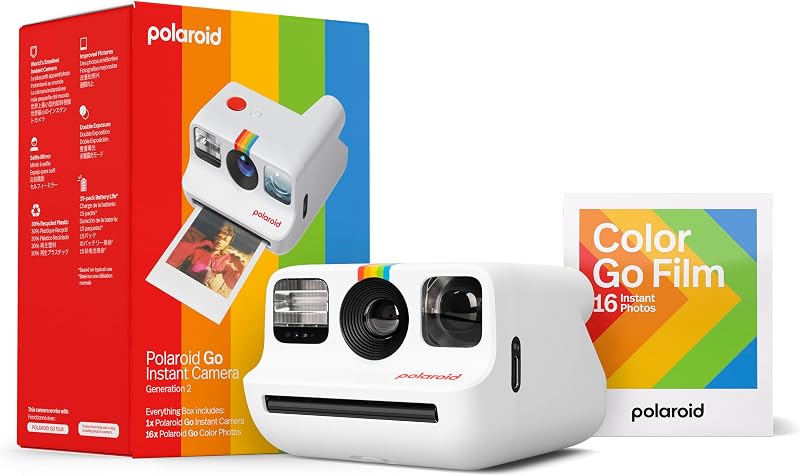
Best for: Minimalist workspaces and everyday pocket travel
Pros
- Pocketable ultra-compact chassis
- Fast rolling shutter speeds
- Reflective optical selfie mirror
- USB-C rechargeable battery
Cons
- No threaded tripod mount
- Produces miniature prints only
Designed specifically to minimize clutter on compact workstations while enabling spontaneous captures, the white Polaroid Go Generation 2 shrinks analog chemistry into an ultra-portable profile. As a truly compact polaroid instant camera, this model slides effortlessly into laptop bags, pencil cases, or shallow desk drawers, remaining accessible whenever inspiration strikes. Fabricated with 30% recycled materials and presented in a clean white chassis, it integrates naturally into bright Scandinavian interiors, modern minimalist desks, and clean aesthetic creative environments without consuming meaningful workspace.
Despite its pocketable dimensions, this generation 2 iteration introduces significant exposure and optical improvements over its predecessor. A re-engineered wide aperture range works alongside an upgraded light sensor to calculate on-point exposure parameters across variable indoor illumination. The shutter mechanism incorporates a rolling shutter capable of speeds spanning from 0.0001 seconds up to a range between 1/300 and 1 seconds, granting versatile control whether capturing daylight scenes or balancing low-light work environments with the built-in flash. The optical viewfinder features a reflective coating that acts as a built-in selfie mirror, making quick desktop self-portraits and progress updates straightforward to frame.
Operational flexibility extends to double-exposure shooting and an automated self-timer, allowing users to layer graphical concepts or step back for wider desk snapshots. The camera pairs with pocketable Polaroid Go film, producing miniature square photos that fit neatly inside daily planners, on the edges of computer displays, or within pocket sketchbooks. Powered by an internal USB-C rechargeable battery that lasts for approximately 15 film packs per charge, it supports continuous workflow documentation. For readers interested in how miniature analog framing compares with competitor formats, reviewing a fujifilm polaroid camera overview provides helpful context on film borders and form factors. However, the Go format gives way to the larger Polaroid Now when large-format prints and physical tripod mounting are required.
- Ultra-compact form factor built with 30% recycled materials fits easily into workspaces.
- Upgraded exposure system with large aperture range and precise light sensor.
- Versatile rolling shutter operating from 0.0001 seconds up to 1/300 – 1 seconds.
- Viewfinder integrated selfie mirror alongside creative double-exposure and timer modes.
03 Polaroid Go Generation 2
The black Polaroid Go Generation 2 delivers the identical miniature analog photographic platform in a discreet, stealthy aesthetic suited to professional recording studios, dark industrial desk setups, and monochrome editing bays. By matching the low-profile dimensions of its white counterpart, this pocketable camera rests unobtrusively beside mechanical keyboards, studio audio interfaces, and external storage arrays. It utilizes the dedicated Polaroid Go instant film format, outputting physical chemical snapshots that develop right before your eyes and offer a tangible counterpoint to digital desktop workflows.
Under the hood, this compact instant print polaroid camera relies on an automatic exposure system and an advanced light sensor to navigate shifting room lighting without manual guesswork. While the listing does not specify a minimum shutter speed for this specific black bundle listing, the maximum shutter speed reaches between 1/300 and 1 seconds, ensuring reliable action freezing and consistent exposure when combined with the built-in flash. The front-facing optical viewfinder houses the signature reflective selfie mirror, allowing creators to compose framed workspace portraits, video call milestones, or team check-ins without awkward misalignment.
Creative features such as double-exposure mode and an integrated self-timer provide experimental freedom without requiring software editing or external hardware. Recharging via a standard USB-C port allows you to top off the internal battery directly from a workstation dock or monitor hub, with each full charge delivering endurance across roughly 15 film packs. While its miniature frame cannot replicate the expansive image area or twin-lens autofocus array of the full-format Polaroid Now 3rd Generation, it provides unmatched agility for creators who prioritize portable documentation. For an understanding of alternative small-format instant film products, exploring our fujifilm instant camera analysis illustrates how Polaroid maintains a distinct, warm analog look even at pocket scale.
- Matte black compact shell constructed from 30% recycled materials blends into studio gear.
- Dedicated double-exposure mode and automatic exposure system for creative experiments.
- Reflective selfie mirror integrated into the optical viewfinder frame.
- USB-C rechargeable battery sustaining up to 15 film packs per charging cycle.
What Sets These Models Apart
Comparing the specifications across these three Polaroid cameras highlights clear distinctions in physical scale, film sheet dimensions, shutter timing, and mounting capabilities. The following table summarizes how each camera aligns with specific workspace requirements and creative imaging habits.
| Model | Compatible Film Formats | Shutter & Optical System | Physical Footprint & Mounting |
|---|---|---|---|
| Polaroid Now 3rd Generation I-Type Instant | Polaroid i-Type and Polaroid 600 | Twin-lens autofocus; maximum shutter speed 1/60 seconds | Full-size classic body; built-in tripod mount |
| Polaroid Go Generation 2 (White) | Polaroid Go | Rolling shutter (0.0001 to 1/300 – 1 seconds); precise light sensor | Ultra-compact pocketable body; no tripod mount |
| Polaroid Go Generation 2 (Black) | Polaroid Go | Rolling shutter (maximum 1/300 – 1 seconds); precise light sensor | Ultra-compact pocketable body; no tripod mount |
Buying Tips for Polaroid Instant Cameras
Operating an analog instant print camera effectively within an office or home studio environment requires a fundamental understanding of instant film chemistry. When a photo ejects from either the Polaroid Now or Polaroid Go, internal metal rollers crush a chemical reagent pod embedded in the bottom border of the sheet, spreading developer paste evenly between the negative and positive emulsion layers. Because these developing chemicals remain sensitive to light during the first few minutes of reaction, you should immediately place newly exposed prints face down on your desk or store them in a dark drawer to prevent washed-out tones and maintain deep, rich contrast.
Workspace lighting conditions directly influence the clarity, color saturation, and sharpness of your analog prints. Instant film emulsions perform best in abundant light, meaning ambient overhead room lighting is frequently insufficient on its own. For indoor desktop documentation, keeping the built-in flash active is essential to avoid muddy exposures and motion blur. If you are shooting with the Polaroid Now 3rd Generation, pairing the camera with a standard desk tripod via its built-in mount will provide rock-solid stability, mitigating the risk of camera shake caused by its 1/60-second maximum shutter speed during detailed desktop product or layout captures.
Finally, align your camera choice with your intended filing, journaling, or organizational workflow. The full-sized frames generated by i-Type film provide commanding visual authority on studio presentation walls, mood boards, and client presentations, but they require generous storage space. By comparison, the miniature prints produced by both Polaroid Go Generation 2 models are exceptionally practical for bullet journaling, indexing project cards, and annotating physical design binders without overwhelming page space.
FAQ
How does Polaroid i-Type film differ from Polaroid Go film?
Polaroid i-Type film produces full-sized classic square prints designed for full-frame cameras such as the Polaroid Now 3rd Generation. Polaroid Go film is a specialized miniature format engineered specifically for the ultra-compact Polaroid Go camera series. The two formats have distinct physical dimensions and chemical cartridge sizes, meaning they are completely incompatible and cannot be interchanged between camera bodies.
Can you turn off the built-in flash when capturing indoor photos?
Both the Polaroid Now 3rd Generation and Polaroid Go Generation 2 feature integrated flash units that coordinate with internal light sensors to provide optimal exposure. While flash controls allow for manual overrides, indoor analog photography without flash often results in dark, underexposed images due to the fixed sensitivity of instant film emulsions, making flash use strongly recommended for workspace shots.
How are these modern Polaroid cameras powered?
Unlike vintage instant cameras that relied on single-use batteries built directly into disposable film packs or separate AA cells, both the Polaroid Now 3rd Generation and the Polaroid Go Generation 2 feature internal rechargeable lithium-ion batteries. Each camera recharges via a modern USB-C connection, with a single full charge providing enough battery life to shoot through over 15 film packs.
Does the Polaroid Go Generation 2 include a standard tripod mount?
No, the Polaroid Go Generation 2 does not include a threaded tripod socket on its body, as its design prioritizes pocketable convenience and minimal carry weight. If your creative workspace workflow requires mounting the camera onto a desk arm, articulated clamp, or standard studio tripod, the Polaroid Now 3rd Generation I-Type Instant includes a dedicated built-in tripod mount.
What does the double-exposure mode do on these Polaroid cameras?
Double-exposure mode allows you to capture two separate images onto a single sheet of film before the camera ejects the print. This creative feature allows you to blend multiple visual elements, such as combining a desk artifact with an ambient portrait or overlaying handwritten typography on top of an office still life, directly within the physical film frame.