As Amazon Associates, we earn from qualifying purchases. This means we may receive a small commission at no extra cost to you if you click through and make a purchase.
Selecting the ideal jbl subwoofer tube or bass enclosure involves balancing low-end acoustic extension with cargo space preservation. Vehicle audio upgrades often compete with day-to-day utility, forcing drivers to weigh trunk capacity against the depth and clarity of their sound system. A well-engineered jbl car subwoofer enclosure resolves this conflict by tailoring bass delivery to your specific vehicle layout, whether you drive a compact hatchback, a family SUV, or a commuter sedan. Understanding the interplay between enclosure geometry, driver displacement, and built-in power helps ensure your audio equipment complements your daily travel routine rather than obstructing groceries, luggage, or tools.
In this jbl subwoofer tube comparison, we evaluate six distinct models from JBL to help you decide which jbl subwoofer tube to buy for your vehicle. These options span self-contained powered tubes and spare-tire units to standalone component drivers and heavy-duty dual-woofer boxes. While some setups feature an integrated jbl powered subwoofer system designed for straightforward installation, others require external amplification and custom mounting enclosures. By examining driver diameters, continuous wattage ratings, cabinet materials, and vehicle integration profiles, you can identify the compact jbl bass enclosure that elevates your commute while respecting your cargo needs.
Which JBL Subwoofer Tubes Should You Buy
- For drivers seeking a complete ported trunk package with built-in power and wired remote adjustment, select the JBL SUBBP12AM.
- For commuters who need total cargo floor retention by mounting bass hardware inside the spare wheel, choose the JBL Basspro Hub.
- For custom audio fabricators designing an affordable mid-size sealed or ported enclosure, pick the JBL 10″ Car Audio Subwoofer.
- For maximum acoustic output and high sound pressure levels from a pre-built slot-ported enclosure, step up to the JBL Dual 12″ Car Audio Ported.
- For tight vehicle cavities requiring a shallow component woofer for custom fiberglass builds, select the JBL Stage 82-8″ Car Audio Subwoofer.
- For discreet under-seat placement that keeps your trunk completely untouched, choose the JBL Basspro SL2.
Measure shown: Weight (lb). Every figure is the number the seller publishes on that product page — nothing on this site is measured by us. Longest bar is highlighted.
01 JBL SUBBP12AM

Best for: Drivers wanting an all-in-one ported trunk sub
Pros
- Integrated 150W RMS amplifier
- Turbulence-reducing Slipstream port
- Included sub level remote control
Cons
- Consumes trunk floor space
The JBL SUBBP12AM provides an all-in-one low-frequency solution by combining a 12-inch polypropylene woofer cone with a factory-matched internal amplifier. Delivering 150 watts RMS and reaching 450 watts peak output, this powered unit eliminates the complexity of matching standalone drivers to outboard amplification. Much like calibrating a jbl home theater system for consistent acoustic delivery, JBL engineered this car audio assembly as a unified system where driver, amplifier, and cabinet work in sync. The floor-standing plastic enclosure incorporates a patented Slipstream port engineered to eliminate air turbulence, preventing port chuffing and distortion during demanding, bass-heavy tracks.
Operating across an audible frequency response range of 35 Hz to 120 Hz, this active enclosure brings authoritative low-frequency impact to vehicle cabins while remaining manageable on the trunk floor. An included wired remote control gives drivers instant command over sub level output from the front seat, enabling quick volume corrections across varying audio sources during daily travel. This unit is an excellent match for drivers who want a substantial 12-inch bass foundation without purchasing outboard gear, though listeners who cannot sacrifice floor area in their trunk will find the spare-tire-mounted Basspro Hub far more accommodating.
- Polypropylene 12-inch woofer cone powered by an integrated 150W RMS and 450W peak amplifier
- Patented Slipstream port geometry engineered to minimize turbulence and port noise
- Operating frequency response spanning 35 Hz to 120 Hz with adjustable sub level remote control
- Floor-standing plastic enclosure designed for stereo vehicle cabin installations
02 JBL Basspro Hub

Best for: Commuters needing complete cargo floor preservation
Pros
- Installs inside spare tire hub
- 200W RMS Class D amplifier
- Rigid fiberglass woofer cone
Cons
- Requires compatible spare tire well
The JBL Basspro Hub is an 11-inch powered subwoofer system engineered specifically to mount directly inside the center hub of a vehicle spare tire. Measuring 14-3/16 inches in diameter and 6-1/2 inches in height, this flush-mount enclosure secures into unused wheel cavity space, allowing daily commuters to preserve their entire trunk volume. The system houses an 11-inch feather-light fiberglass woofer cone supported by a resilient rubber surround, powered by an onboard Class D amplifier that produces 200 watts RMS. This design solves cargo limitations for drivers who haul sports equipment, tools, or luggage while desiring full-range audio performance.
The acoustic output is bolstered by an onboard variable bass boost ranging from 0 to 12 dB fixed at 50 Hz, operating across a wide frequency response of 30 Hz to 150 Hz. JBL packages this system with vehicle attachment hardware, an application-specific wiring harness, and a remote controller with a five-meter cable for convenient driver-seat adjustments. Built-in thermal and electrical safety mechanisms, including over-temperature protection and over-current protection, guard the components against damage during long road trips. This system is ideal for drivers prioritizing concealed equipment, though vehicles lacking a spare tire compartment must turn to traditional enclosures like the SUBBP12AM.
- Spare tire hub installation footprint measuring 14-3/16 inches in diameter by 6-1/2 inches high
- Class D internal amplifier supplying 200W RMS with variable bass boost from 0 to 12 dB at 50 Hz
- Fiberglass 11-inch woofer cone with rubber surround covering 30 Hz to 150 Hz
- Complete installation kit including vehicle mounting hardware, wiring harness, and 5-meter wired remote
03 JBL 10″ Car Audio Subwoofer

Best for: Custom builders designing moderate-power trunk systems
Pros
- Handles 225W RMS power
- Airflow-cooled 1.5-inch voice coil
- Works in sealed or ported boxes
Cons
- Requires separate enclosure and amp
The JBL 10″ Car Audio Subwoofer, bearing the Stage 102AM model designation, offers a dependable component foundation for audio enthusiasts designing a tailored bass setup. Featuring a 10-inch polypropylene cone reinforced by a high-roll rubber surround, this driver handles physical stress in vehicle trunks while ensuring linear excursion. Rated to handle 225 watts RMS and up to 900 watts peak power, the woofer produces punchy bass response when paired with a compatible mono or multi-channel amplifier. JBL subjects these Stage drivers to environmental testing regimens, including thermal baking, freezing, and full-power endurance cycles to confirm operational longevity.
Thermal management is supported by a 1.5-inch voice coil cooled by forced airflow generated through the cone movement itself, preventing voice coil overheating during extended playback. This component driver accommodates either sealed boxes for tight acoustic response or ported configurations for increased low-end output. It serves as a practical option for builders who prefer selecting their own amplifier and enclosure parameters, but those seeking an immediate out-of-the-box solution will prefer pre-loaded enclosures like the Stage 1200D. Note that the listing states the protective woofer grille is not included with this standalone driver.
- Polypropylene cone paired with high-roll rubber surround handling 225W RMS and 900W peak
- Airflow-cooled 1.5-inch voice coil designed for thermal stability under high-demand operation
- Acoustic versatility compatible with both sealed and vented aftermarket enclosures
- Rigid environmental testing validation backed by a 1-year manufacturer warranty
04 JBL Dual 12″ Car Audio Ported
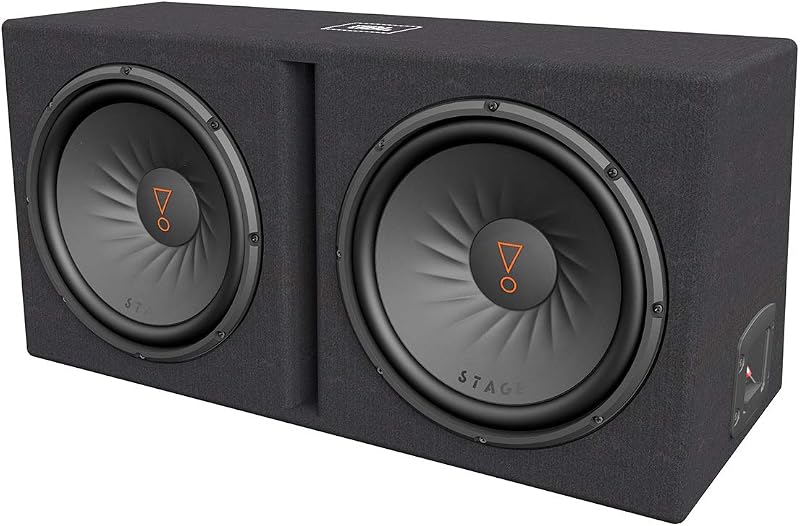
Best for: Bass enthusiasts demanding high sound pressure levels
Pros
- Dual 12-inch woofers handle 500W RMS
- Tuned 5/8-inch MDF slot port
- 2-ohm impedance maximizes mono amps
Cons
- Large footprint consumes trunk capacity
For listeners seeking maximum sound pressure and physical cabin resonance, the JBL Dual 12″ Car Audio Ported enclosure delivers substantial bass output. Factory-loaded with two Stage 122AM 12-inch subwoofers, this system handles 500 watts RMS of continuous power. Rather than spending time sourcing empty cabinets like an aftermarket q bomb 12 inch subwoofer box, users receive an engineered slot-ported cabinet constructed from 5/8-inch medium-density fiberboard (MDF) designed to optimize driver efficiency straight from the factory.
The Stage 1200D enclosure presents a final 2-ohm total impedance, allowing compatible mono car audio amplifiers to extract peak wattage output without complex parallel wiring schemes. Large voice coils and lightweight 12-inch cones maintain note-perfect accuracy and sustained low-end impact during high-volume playback. While the slim enclosure profile helps it rest against rear seatbacks, its dual-woofer footprint still demands significant trunk volume. It remains the top pick for sheer sound pressure levels, though commuters with compact trunks will find it too imposing compared to the slim Basspro SL2.
- Dual 12-inch Stage 122AM woofers handling 500W RMS of continuous power
- Slot-ported enclosure crafted from rugged 5/8-inch MDF engineered for low acoustic distortion
- System impedance configured to 2 ohms to maximize mono block amplifier output
- HARMAN standard reliability testing across thermal extremes, vibration, and ultraviolet exposure
05 JBL Stage 82-8″ Car Audio Subwoofer
Best for: Tight vehicle spaces needing custom component bass
Pros
- Shallow 3.94-inch mounting depth
- Handles 200W RMS power
- Airflow-cooled voice coil
Cons
- Grille and enclosure not included
The JBL Stage 82-8″ Car Audio Subwoofer, cataloged as the Stage 82AM, is a compact component driver engineered for installations where space constraints prevent large enclosures. With an outer diameter of eight inches and a shallow mounting depth profile of 3.94 inches, this woofer fits into custom under-seat boxes, footwell enclosures, or molded side-panel trunk corners. The driver features a stiff polypropylene cone bonded to a high-roll rubber surround, allowing it to handle 200 watts RMS without cone flexing or edge distortion during rapid dynamic transitions.
A 1.5-inch voice coil receives continuous airflow cooling driven by the mechanical motion of the cone, maintaining electrical efficiency during long highway commutes. This driver performs well in compact sealed enclosures for balanced acoustic accuracy or small ported designs for augmented low-end efficiency. It is tailored for custom audio installers seeking reputable JBL component engineering for tight installations. However, because it requires an outboard amplifier, dedicated wiring, and custom enclosure fabrication, users wanting a plug-and-play under-seat solution will find the Basspro SL2 considerably more convenient.
- Shallow 8-inch polypropylene woofer cone with high-roll rubber surround
- Continuous power handling rated at 200W RMS backed by a 1.5-inch voice coil
- Compact physical dimensions measuring 8 inches wide by 8 inches deep by 3.94 inches high
- Designed for sealed or ported applications and backed by a 1-year manufacturer warranty
06 JBL Basspro SL2
Best for: Drivers seeking hidden under-seat bass reinforcement
Pros
- Ultra-slim 2-13/16 inch height
- Built-in 125W RMS digital amplifier
- Adjustable crossover and bass boost
Cons
- Less deep sub-bass output
When trunk space cannot be surrendered, the JBL Basspro SL2 brings low-end reinforcement directly under the driver or passenger seat. This compact powered enclosure pairs an 8-inch shallow-profile subwoofer with an energy-efficient Class D digital amplifier supplying 125 watts RMS. Measuring 13-9/16 inches long, 9-7/8 inches wide, and just 2-13/16 inches high, the plastic housing easily slides beneath seat adjustment rails in passenger cars, trucks, and compact hatchbacks without interfering with rear passenger legroom.
The unit features an electronic crossover, flexible EQ controls, and a variable bass boost adjusting from 0 dB to plus 9 dB centered at 70 Hz. The frequency response ranges from 35 Hz to 120 Hz, restoring the low-end weight that factory door speakers fail to produce. Much like integrating a vizio 2.1 soundbar wireless subwoofer to round out living room audio without bulky floor equipment, the Basspro SL2 restores bass presence without altering vehicle utility. It suits daily commuters who want hidden bass, though it yields absolute low-frequency depth to the larger SUBBP12AM.
- Ultra-slim under-seat profile measuring 13-9/16 by 9-7/8 by 2-13/16 inches
- Built-in Class D digital amplifier outputting 125W RMS
- Operating frequency response of 35 Hz to 120 Hz with adjustable low-pass crossover
- Variable bass boost providing up to +9 dB at 70 Hz for customized cabin acoustics
What Sets These Models Apart
| Model | Driver Size | RMS Power Rating | Enclosure Format | Vehicle Placement Profile |
|---|---|---|---|---|
| JBL SUBBP12AM | 12 inches | 150W RMS (450W Peak) | Powered Slipstream Ported | Trunk floor standing |
| JBL Basspro Hub | 11 inches | 200W RMS | Powered Sealed Enclosure | Spare tire wheel well |
| JBL 10″ Car Audio Subwoofer | 10 inches | 225W RMS (900W Peak) | Component Driver Only | Custom trunk enclosure |
| JBL Dual 12″ Car Audio Ported | Dual 12 inches | 500W RMS | Passive Slot-Ported MDF | Large trunk cargo area |
| JBL Stage 82-8″ Car Audio Subwoofer | 8 inches | 200W RMS | Component Driver Only | Custom compact enclosure |
| JBL Basspro SL2 | 8 inches | 125W RMS | Powered Slim Sealed | Under-seat floor mount |
Buying Tips for JBL Subwoofer Tubes
Evaluating vehicle space and daily utility represents the first step when choosing a bass enclosure. If you regularly transport groceries, golf clubs, or work equipment, floor-standing trunk boxes like the SUBBP12AM or dual 12-inch Stage 1200D may prove restrictive despite their acoustic output. In those scenarios, specialized designs like the Basspro Hub utilize dead space inside the spare wheel well, while the ultra-compact Basspro SL2 mounts beneath front seating tracks, ensuring your primary cargo area remains completely open for routine errands.
Understanding the distinction between powered and component hardware is equally critical for planning your installation. Powered models like the SUBBP12AM, Basspro Hub, and Basspro SL2 contain factory-matched amplifiers within their enclosures, requiring only power, ground, and audio signal wiring. Conversely, component subwoofers such as the Stage 102AM and Stage 82AM, along with the passive Stage 1200D enclosure, require external amplifiers, proper gauge wiring kits, and appropriate impedance matching to function safely and effectively.
Finally, consider the control methods and acoustic tuning capabilities integrated into each setup. Models equipped with wired remote level controllers allow drivers to adjust low-frequency intensity directly from the console, which helps balance older audio recordings and podcast vocals against modern bass-heavy music. Ensuring your chosen model includes flexible low-pass crossovers and bass boost controls guarantees a smooth acoustic blend between your subwoofer and factory door speakers.
FAQ
How does a powered subwoofer differ from a passive component subwoofer?
A powered subwoofer integrates both the speaker cone and a matched amplifier into a single enclosure, streamlining installation and eliminating external amp mounting. A passive component subwoofer contains only the speaker driver, requiring a separate enclosure and an outboard amplifier to supply power.
Can the JBL Basspro Hub be installed in every vehicle?
The Basspro Hub requires a central spare tire compartment with a compatible hub cavity measuring at least 14-3/16 inches wide and 6-1/2 inches deep. Vehicles that utilize run-flat tires or carry tire repair kits without a physical spare tire well cannot accommodate this specific unit.
What does the Slipstream port on the JBL SUBBP12AM do?
The Slipstream port features a specialized flared geometry that regulates airflow exiting the enclosure. This design minimizes internal air turbulence, preventing the chuffing and port noise common in standard ported boxes during high-volume, low-frequency playback.
Why does the JBL Dual 12″ Car Audio Ported enclosure use a 2-ohm impedance?
The 2-ohm total system impedance allows compatible mono block car amplifiers to deliver higher continuous wattage compared to higher impedance loads. This enables the dual-woofer system to extract maximum power output from the amplifier efficiently.
Will an under-seat subwoofer like the JBL Basspro SL2 vibrate the front seat?
Because the Basspro SL2 mounts directly beneath the seat rails, listeners will feel physical tactile vibrations during deep bass notes. This tactile energy enhances the perceived bass impact while allowing the audio system to operate at lower volume levels throughout the cabin.