As Amazon Associates, we earn from qualifying purchases. This means we may receive a small commission at no extra cost to you if you click through and make a purchase.
A dependable workstation begins with a clean connection between your computer and your desk peripherals. When searching for a plugable usb 3.0 docking station, the primary goal is expanding a single laptop port into a comprehensive hub that manages dual monitors, stable Gigabit Ethernet, and numerous USB accessories. Modern ultra-thin laptops frequently sacrifice peripheral ports to maintain slim profiles, forcing professionals to constantly swap cables between meetings. Integrating a dedicated desktop dock resolves this friction by establishing a permanent landing zone where external screens, input peripherals, and local network cables remain connected and ready for immediate productivity.
This comprehensive guide examines four distinct docking stations from Plugable to help you identify the right model for your specific desk arrangement. While every option in this lineup expands desktop connectivity through proven graphics compression technology, they differ substantially in monitor display capacity, host connection style, port arrangement, and laptop charging capability. In this plugable docking station comparison, we break down how basic USB 3.0 units contrast with higher-end USB-C options, exploring how each model handles multi-monitor output, device power delivery, and day-to-day workflow demands.
Which Plugable Docking Stations Should You Buy
- Plugable USB 3.0 Universal Laptop Docking: Best for home office setups requiring split microphone and audio ports alongside dual HDMI monitors over USB-A or USB-C.
- Plugable Dual 1080p HDMI Universal Docking: Best for standardized corporate and mixed-OS workstations that need a compact vertical footprint and included USB-C and USB-A host cables.
- Plugable USB 3.0 Universal Docking Station: Best for desktop users who prefer a low-profile horizontal enclosure with flexible display connectivity for office productivity applications.
- Plugable USB C Triple Display Docking: Best for multi-tasking professionals demanding triple display outputs and integrated 100W USB-C Power Delivery through a single host connection.
Measure shown: Weight (lb). Every figure is the number the seller publishes on that product page — nothing on this site is measured by us. Longest bar is highlighted.
01 Plugable USB 3.0 Universal Laptop Docking

Best for: Horizontal desk setups requiring flexible display connectivity
Pros
- Low-profile horizontal chassis
- Twelve total peripheral expansion ports
- Corporate driver deployment support
Cons
- Does not charge host system
- Single native HDMI port

Best for: Home offices needing split mic and headphone ports
Pros
- Hybrid USB-A and USB-C cable
- Separate audio and mic jacks
- Dual HDMI video outputs
Cons
- Does not charge host laptop
- No HDCP streaming support
The Plugable USB 3.0 Universal Laptop Docking station provides a well-rounded foundation for transforming portable computers into fully functional desktop workstations. Featuring a versatile hybrid 2-in-1 USB 3.0 and USB-C host cable, this unit connects smoothly to older USB-A computers as well as modern USB-C laptops. It expands the host machine into twelve total ports, incorporating two HDMI video outputs, wired Gigabit Ethernet, two front-facing USB 3.0 data ports, four rear USB 2.0 ports, and discrete 3.5 mm headphone and microphone jacks. The hardware relies on DisplayLink graphics processing to output clear video across dual screens up to 1920×1200 at 60Hz, while single display setups can achieve 2560×1440 at 50Hz.
In a daily workstation routine, this docking station shines by keeping desktop cabling neatly routed behind its upright standing chassis. With its dedicated 20-watt power supply, the unit provides stable power to all connected accessories, ensuring external hard drives and networking hardware function reliably. However, it is essential to understand that this dock does not provide host system charging; your laptop must remain connected to its factory power supply during use. For environments where users frequently switch between legacy notebooks and newer work machines, this model bridges the gap without requiring specialized port adapters.
While the dock delivers exceptional stability for spreadsheets, web browsing, and general business applications, the listing notes clear boundaries regarding performance use cases. It does not support hardware gaming, DisplayPort monitors, or HDCP-encrypted streaming services such as Netflix. If your workstation requires alternative port expansion from competing accessory ecosystems, reviewing a wavlink usb 3.0 roundup can provide helpful context regarding peripheral bandwidth. For standard corporate workloads requiring dual external monitors and TAA compliance, this unit remains a dependable home office staple.
- Hybrid 2-in-1 host connection supporting native USB-A and USB-C computers
- Dual HDMI outputs supporting resolutions up to 1920×1200 at 60Hz
- Dedicated 3.5 mm headphone output and microphone input jacks
- Six total USB ports including two front USB 3.0 and four rear USB 2.0 connections
02 Plugable Dual 1080p HDMI Universal Docking
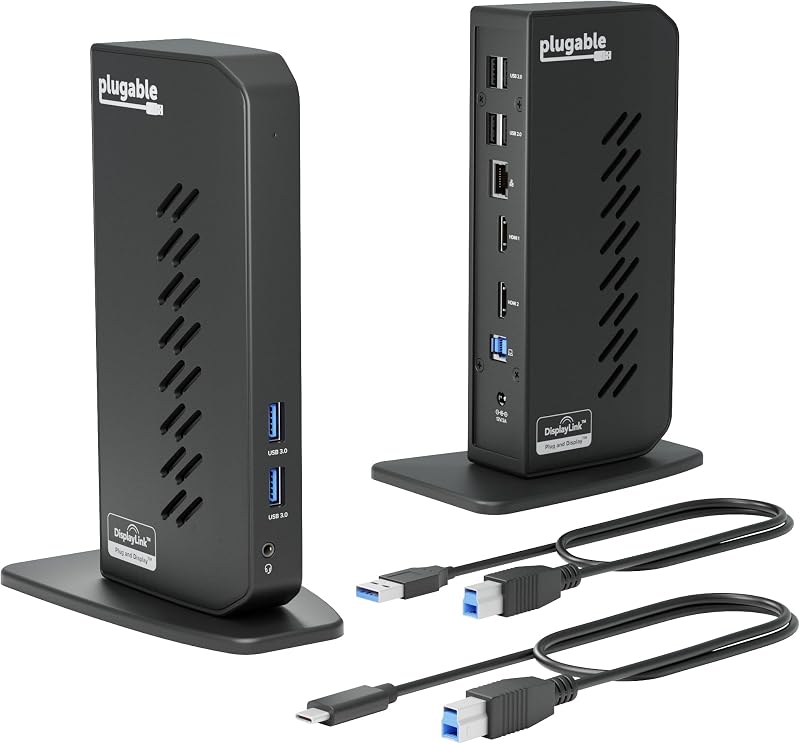
Best for: Multi-OS workstations and Apple Silicon MacBook users
Pros
- Includes USB-A and USB-C cables
- Space-saving upright tower design
- Dual 1080p display support
Cons
- No host laptop power delivery
- Not intended for PC gaming
Workstation deployments in corporate or mixed-platform settings benefit significantly from the Plugable Dual 1080p HDMI Universal Docking station. Engineered to standardize desktop setups across varying operating systems, this unit supports Windows, macOS, and ChromeOS with minimal administrative hassle. Windows machines receive drivers automatically through Windows Update, while ChromeOS version 100 or later functions without manual configuration. On macOS systems, including modern Apple Silicon computers from M1 through M5 and Neo architectures, installing the DisplayLink manager software allows users to overcome native single-display limitations and run dual independent displays.
This plugable dual monitor dock includes both separate USB-C and USB-A host connection cables in the box, preventing compatibility bottlenecks when team members bring different hardware into shared hot-desking spaces. Its vertical profile conserves valuable desktop real estate while organizing twelve ports: two HDMI outputs running up to 1920×1200, two 5Gbps USB ports, four USB 2.0 ports for keyboards and mice, wired Gigabit Ethernet, and a combined 3.5mm audio jack. Operating via an included 24-watt power adapter, it powers every plugged-in peripheral smoothly throughout demanding workdays.
Designed primarily for office software, cloud applications, and data management, this docking station delivers stable daily performance. Like other DisplayLink-based universal docks, it does not support HDCP copy-protected content playback and is not intended for gaming or high-frame-rate full-screen video rendering. It does not supply power to the host computer, so users must continue plugging in their laptop chargers. For organizations seeking uniform desk connectivity that works seamlessly across multi-generation MacBooks and Windows PCs, this model offers a streamlined, IT-friendly solution.
- Expands external display capabilities on Apple Silicon M1 through M5 and Neo laptops
- Ships with separate USB-C and USB-A host connection cables
- Space-saving vertical orientation that minimizes desktop footprint
- Ten external expansion ports alongside dual HDMI 1080p video outputs
03 Plugable USB 3.0 Universal Docking Station
Users who prefer a horizontal desk footprint often turn to the Plugable USB 3.0 Universal Docking Station (model UD-3900H). This low-profile dock lays flat beneath monitors or neatly beside laptop risers, measuring 9.4 inches wide and just 1.2 inches high. It features broad operating system compatibility across Windows 7 through 11, macOS 10.14 and later, and ChromeOS 100.x or newer. Its architecture supports DisplayLink corporate installer deployment, making it straightforward for enterprise IT departments to manage widespread workstation rollouts without individual desk troubleshooting.
The UD-3900H provides 12-port expansion, pairing two display outputs with six USB ports, wired Ethernet, and audio jacks. Dual displays are supported at resolutions up to 1920×1200 at a 60Hz refresh rate. The first video output is a standard HDMI port, while the secondary video output offers broad display connectivity to accommodate diverse office monitors. By handling multi-monitor video traffic through software compression, it successfully enables dual extended displays on Apple Silicon machines, including M1 through M5 and Neo platforms, that otherwise support only one native external screen.
In everyday desk use, the UD-3900H keeps essential office accessories running without consuming excess desk space. Operating on an included 24-watt power supply, it easily handles high-draw external drives alongside low-speed wireless keyboard receivers. Host charging is not supported, meaning your notebook charger remains necessary. If your daily workflow requires ultra-high-definition multi-screen output, exploring a dedicated plugable usb-c dual 4k hdmi docking station might better suit high-density graphic requirements, whereas this horizontal dock remains an exceptional choice for standard office productivity.
- Horizontal low-profile chassis designed for neat placement under monitor stands
- Twelve-port expansion hub accommodating mixed legacy and modern peripherals
- DisplayLink technology driving dual screens up to 1920×1200 at 60Hz
- Broad platform support across Windows, ChromeOS, and Apple Silicon hardware
04 Plugable USB C Triple Display Docking

Best for: Power users needing triple displays and charging
Pros
- 100W USB-C host power delivery
- Triple extended HDMI monitor support
- Primary display supports 4K resolution
Cons
- Requires host USB-C Alt Mode
- Higher operating wattage requirement
For power users demanding extensive screen real estate and true single-cable convenience, the Plugable USB C Triple Display Docking station stands as the flagship choice in this lineup. Unlike traditional USB 3.0 hardware, this plugable multi display docking station connects via USB-C, USB4, or Thunderbolt to supply both high-bandwidth peripheral communication and 100 watts of USB-C Power Delivery directly to the host laptop. This eliminates the need for a separate laptop charging brick, clearing power strips and reducing desk clutter down to a single umbilical connection.
The display architecture on this dock utilizes a hybrid design: it features one native HDMI output delivering 4K resolution at 30Hz via USB-C DisplayPort Alternate Mode, alongside two additional HDMI outputs running at 1080p at 60Hz powered by integrated DisplayLink technology. This intelligent pairing allows users to connect up to three external screens simultaneously, even bypassing native single-display limitations on Apple Silicon M1, M2, M3, and Neo MacBooks. The 100-watt power capability ensures that even demanding business notebooks stay fully charged while driving all three monitors, a wired Gigabit Ethernet network, audio output, and multiple connected USB peripherals.
Equipped with six USB 3.0 data ports, this unit handles high-speed data transfers across multiple external storage drives, webcams, and accessory hubs concurrently. Because it relies partly on DisplayPort Alternate Mode and Power Delivery standards, the host computer must have a fully capable USB-C or Thunderbolt port to access all features. When deciding plugable usb c docking station options for an advanced workstation, this triple-monitor dock offers an enterprise-grade upgrade over standard dual-screen USB 3.0 units, making it perfect for financial analysts, developers, and data-heavy workflows.
- Triple external HDMI display support combining 4K Alt Mode and dual 1080p DisplayLink outputs
- Integrated 100W USB-C Power Delivery to charge host laptops over one cable
- Six high-speed USB 3.0 data ports for extensive peripheral expansion
- Engineered for modern USB-C, USB4, and Thunderbolt computers running Windows, macOS, or ChromeOS
What Sets These Models Apart
| Model | Maximum Displays & Resolution | Host Connection & Power Delivery | Total USB Ports | Form Factor & Chassis |
|---|---|---|---|---|
| Plugable USB 3.0 Universal Laptop Docking | Dual HDMI up to 1920×1200 @ 60Hz (Single up to 2560×1440 @ 50Hz) | Hybrid 2-in-1 USB 3.0 / USB-C (No Host Charging) | 6 Ports (2x USB 3.0, 4x USB 2.0) | Vertical Tower (4.9″ x 2.8″ x 7.7″) |
| Plugable Dual 1080p HDMI Universal Docking | Dual HDMI up to 1920×1200 @ 60Hz | Separate USB-C and USB-A Cables (No Host Charging) | 6 Ports (2x USB 3.0, 4x USB 2.0) | Vertical Tower (5.31″ x 2.76″ x 7.48″) |
| Plugable USB 3.0 Universal Docking Station | Dual Displays up to 1920×1200 @ 60Hz (1x HDMI, 1x Flexible) | USB Host Cable (No Host Charging) | 6 Ports (Configuration Not Specified) | Horizontal Desktop (9.4″ x 3.1″ x 1.2″) |
| Plugable USB C Triple Display Docking | Triple HDMI (1x 4K @ 30Hz, 2x 1080p @ 60Hz) | USB Type-C with 100W Power Delivery | 6 Ports (6x USB 3.0) | Horizontal Low-Profile (3.3″ x 7.9″ x 1.2″) |
Buying Tips for Plugable Docking Stations
Choosing the right plugable displaylink dock requires matching your laptop hardware ports with your daily productivity requirements. If you use a computer equipped only with standard USB-A ports or an older USB-C connection without power passthrough, a standard USB 3.0 docking station is the practical choice. These universal models convert standard USB data channels into video, networking, and audio streams via onboard graphics processing. However, you must plan your desk space with the knowledge that you will still need to plug your laptop into its standalone manufacturer charging adapter every time you work.
Display technology represents another critical buying consideration. Most universal docks that rely purely on DisplayLink compress graphic information into USB data packets before rebuilding the video feed inside the dock. While this enables multi-monitor functionality across MacBooks that natively support only one external screen, it carries operational trade-offs. DisplayLink connections cannot decode HDCP copy protection, preventing video playback from streaming services like Netflix or Hulu, and they introduce slight latency that makes them unsuitable for competitive PC gaming. For spreadsheets, email, research, and standard video calls, however, the video stability is smooth and dependable.
Finally, inspect your monitor cabling and desktop arrangement before finalizing your setup. If you plan to connect three screens and eliminate extra charging bricks, a modern USB-C docking station with 100W Power Delivery is well worth the hardware upgrade, provided your laptop port explicitly supports DisplayPort Alternate Mode. When setting up multi-screen environments, pairing quality displays with reliable video cords like an hdmi 2.1 anker connection helps maintain signal integrity across extended daily sessions without visual dropouts or flickering.
FAQ
Do Plugable USB 3.0 docking stations charge connected laptops?
Standard Plugable USB 3.0 docking stations do not charge your laptop. These models use their internal power supplies solely to operate the dock hardware and provide power to connected USB accessories, networking hardware, and audio outputs. You must keep your laptop connected to its original manufacturer power adapter during use. Only advanced USB-C models equipped with Power Delivery, such as the 100W Triple Display dock, can charge the host computer over a single connection cable.
Can you watch protected video streams like Netflix through these docking stations?
Universal docking stations that rely on DisplayLink compression graphics do not support High-bandwidth Digital Content Protection (HDCP). When attempting to stream encrypted content from commercial services such as Netflix, Hulu, or Amazon Prime Video across a DisplayLink-driven monitor, the video feed will typically show a blank or black screen while audio continues playing. These docks are engineered strictly for web browsing, office software, and general productivity workflows rather than protected media playback.
How do Plugable docks enable dual displays on base Apple Silicon MacBooks?
Base Apple Silicon computers, including standard M1, M2, and M3 MacBooks, feature hardware display controller limits that permit only one native external monitor over standard display outputs. Plugable universal docks overcome this barrier by utilizing DisplayLink technology. Instead of requiring a native video pipeline from the graphics card, the dock uses a driver on macOS to compress screen data and send it over standard USB channels, allowing the dock hardware to reconstruct the image and run dual independent displays.
Do you need to install drivers to use a Plugable docking station?
Driver requirements depend entirely on your computer operating system. On Windows 10 and 11, the necessary DisplayLink graphics drivers install automatically through Windows Update once the dock is connected to an active internet network. On ChromeOS version 100 or higher, driver support is built directly into the operating system without manual intervention. For macOS machines, users must manually download and install the DisplayLink Manager application to enable external video output across connected screens.
Can you use a Plugable USB 3.0 dock for PC gaming?
Plugable USB 3.0 universal docks are not recommended for gaming. Because these devices translate visual information using CPU-assisted compression before transmitting it over USB channels, the process introduces minor display latency and frame overhead that hampers fast-paced gaming performance. Furthermore, these docks lack support for specialized graphics card features, variable refresh rates, and hardware synchronization. They are tailored specifically for office applications, web browsing, and multi-window productivity tasks.