As Amazon Associates, we earn from qualifying purchases. This means we may receive a small commission at no extra cost to you if you click through and make a purchase.
Stationary optical observation from an apartment balcony, home study desk, or corner window ledge requires balancing objective aperture against physical desk footprint. When considering a high-end option like a zeiss spotting scope 85mm class setup or its companion configurations, the primary consideration comes down to light transmission versus bulk. Stationary home observers need an optic that can remain mounted on a sturdy desk rig or window clamp without crowding daily work surfaces, yet still provide the resolving power required to inspect distant ridgelines, harbor traffic, or nesting raptors across the neighborhood tree line.
This zeiss spotting scopes comparison covers exactly three distinct configurations from the brand, each serving a different stage of a stationary viewing routine. They differ sharply in optical architecture, footprint, and protective intent: one listing provides the dedicated stay-on neoprene armor engineered for 85mm glass, another delivers a self-contained compact 65mm angled observation optic with integrated Arca-Swiss mounting, and the third provides a massive 95mm flagship objective body built for extreme reach and wide-field panoramic scanning. Understanding how these listings differ ensures you choose the right piece of glass for your daily viewing station.
Which ZEISS Spotting Scope Should You Buy
- Balcony observation posts needing all-weather armor: ZEISS Conquest Gavia 85 Spotting Scope
- Compact study window ledges and quick digital capture: ZEISS Conquest Apia 20-50×65 Compact Angled
- High-magnification panoramic balcony viewing across vast distances: ZEISS Victory Harpia 95 Spotting Scope
Measure shown: Weight (lb). Every figure is the number the seller publishes on that product page — nothing on this site is measured by us. Longest bar is highlighted.
01 ZEISS Conquest Gavia 85 Spotting Scope
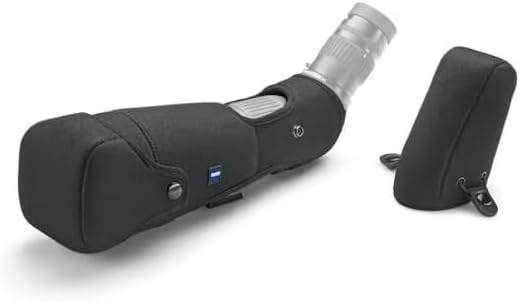
Best for: Weatherproof balcony protection and stay-on casing
Pros
- Durable neoprene build
- Stay-on quick access
- Secure snap-on lens caps
Cons
- Listing provides protective case only
The ZEISS Conquest Gavia 85 Spotting Scope listing supplies the dedicated stay-on neoprene carrying case designed specifically for the Conquest Gavia 85 platform. For an outdoor balcony station or an exposed study terrace where mist, morning condensation, and sudden weather shifts threaten precision optics, this protective solution ensures the large 85mm optic remains shielded without having to be packed away inside a drawer between viewing sessions. The listing notes that the case is constructed from durable, waterproof neoprene, providing a secure barrier against rain and accidental contact with railing edges.
Operational speed is critical when tracking transient wildlife from a home window, and this setup addresses access through articulated flaps. The eyepiece and objective lens sections unsnap quickly so you can start viewing immediately without stripping the protective shell from the scope body. Furthermore, the objective and eyepiece caps snap directly to the main body when open, preventing loose covers from dangling erratically in high winds or blowing off an elevated balcony floor. The listing highlights an overall item weight of 5.36 ounces and package dimensions of 17 by 5.25 by 5.25 inches, making it a streamlined exterior shell backed by a limited lifetime warranty.
For observers establishing a zeiss spotting scope balcony setup, this protective housing allows an 85mm instrument to stay semi-permanently mounted on a heavy tripod without accumulating dust or moisture on the mechanical barrels. While readers examining general optics in our maven spotting scope guide often look at basic dust covers, this ZEISS system allows full operational access while fully encased. It is important to note that this specific listing delivers the protective case rather than the internal glass lenses or prism assembly; readers seeking an out-of-the-box complete optical barrel will want to evaluate the fully integrated Apia 65 or pair this protective unit with its matching 85mm optical core.
- Waterproof neoprene construction that shields delicate mechanical barrels from balcony moisture
- Unsnapping objective and eyepiece covers that allow immediate viewing without case removal
- Snap-to-body cap retention system designed to prevent loose covers from blowing off high decks
- Lightweight 5.36-ounce profile backed by a limited lifetime warranty
02 ZEISS Conquest Apia 20-50×65 Compact Angled

Best for: Compact home office window sill stations
Pros
- FieldFlattener edge-to-edge clarity
- Direct Arca-Swiss tripod mount
- Detachable rapid zoom lever
Cons
- Modest 65mm light collection
The ZEISS Conquest Apia 20-50×65 Compact Angled offers a self-contained, high-performance viewing system tailored for compact spaces. Engineered with an overall length of 11.7 inches and an overall weight of 3 pounds, this scope delivers a space-conscious footprint that sits comfortably on a desk clamp or deep interior window sill without encroaching on monitors, lamps, or paperwork. The optical train combines a 6.5-centimeter (65mm) objective lens with a continuous 20x to 50x zoom range, providing an agile sweet spot for casual morning scanning and detailed target identification across town.
Optically, the zeiss conquest apia 20-50×65 integrates extra-low dispersion (ED) glass treated with proprietary ZEISS T* multi-coatings to ensure vivid, high-contrast imagery even when observing in challenging daylight. It also incorporates ZEISS FieldFlattener Technology, which corrects spherical aberrations to produce crisp, edge-to-edge sharpness across the entire 144-foot field of view. To protect external optical surfaces against humidity, condensation, and rain, the glass features hydrophobic LotuTec coating. The included Apia eyepiece provides extended eye relief, minimizing eye fatigue during prolonged desk-side scanning sessions.
Mechanical integration is where this model excels as a zeiss angled spotting scope for window applications. The scope body includes an integrated Arca-Swiss compatible tripod mount that locks directly into contemporary ball heads and desk clamps without requiring clumsy adapter plates. It features protective rubber armoring, an optimally balanced center of gravity, and a detachable throw lever that allows smooth, one-handed zoom adjustments while keeping your other hand on a mouse or notebook. Our technical breakdown of the sony cybershot camera carl zeiss partnership explores how these proprietary T* lens treatments combat interior window glare during high-contrast daylight hours. Observers should note that the 65mm objective gathers less twilight illumination than an 85mm or 95mm scope, but its compact footprint makes it significantly easier to position in tight indoor spaces.
- Integrated Arca-Swiss tripod foot for immediate attachment to desk clamps and window mounts
- ZEISS FieldFlattener Technology delivering flat, edge-to-edge clarity across a 144-foot field of view
- Versatile 20x to 50x zoom range equipped with a detachable rapid-adjustment throw lever
- Coated eyepiece with long eye relief and hydrophobic LotuTec lens treatments
03 ZEISS Victory Harpia 95 Spotting Scope

Best for: High-magnification panoramic balcony viewing
Pros
- Massive 95mm objective lens
- Expansive 72-degree ComfortVision
- DualSpeed rapid and fine focus
Cons
- Eyepiece sold separately
The ZEISS Victory Harpia 95 Spotting Scope body represents the pinnacle of stationary light-gathering capability. Centered around a massive 95-millimeter (9-centimeter) objective lens assembly, this high-magnification instrument is built for permanent observation posts where distance and resolving power are the absolute priorities. Designed to reach up to 70x magnification via its 3x wide-angle optical system, the Harpia 95 transforms distant horizons, maritime channels, and alpine peaks into rich, intimate scenes from the comfort of a dedicated viewing chair.
The optical system utilizes custom FL fluoride glass elements that practically eliminate secondary chromatic aberration, preserving razor-sharp subject edges and faithful color fidelity even when pushed to its maximum 70x reach. One of the defining attributes of the zeiss victory harpia 95 spotting scope is the ComfortVision Concept, which maintains an expansive subjective 72-degree field of view across the entire zoom range. Unlike conventional scopes that narrow down to a restrictive tunnel at peak zoom, this wide-angle architecture maintains panoramic situational awareness so you can track moving subjects without losing your bearings.
Focusing precision is managed by the DualSpeed focus mechanism, an innovative mechanical system that automatically switches between rapid adjustment for quick subject location and ultra-fine micro-focusing as you refine the image. Every lens is individually treated with ZEISS T* anti-reflective coatings, alongside LotuTec repelling coatings for all-weather clarity. As we noted in our barska spotting scope comparison, heavy optical barrels demand rigid vibration dampening to unlock their full resolving power. This product listing represents the spotting scope body only, meaning the eyepiece must be secured as an individual component to complete the optical path, and its physical heft requires a robust, dedicated balcony tripod rather than a lightweight window sill clamp.
- Massive 95mm objective diameter delivering unmatched resolving power in low morning light
- ComfortVision optical architecture providing a constant 72-degree subjective field of view
- DualSpeed focus system featuring automatic switching between rapid and fine focus travel
- FL fluoride glass construction tuned with individually customized T* lens coatings
What Sets These Models Apart
Choosing between these ZEISS options requires matching physical bulk and optical capability to your specific observation post. High-magnification optics require steady physical support, and larger objective lenses demand heavier mounting hardware. The table below outlines the mechanical and optical specifications across these three listings.
| Feature | ZEISS Conquest Gavia 85 Spotting Scope | ZEISS Conquest Apia 20-50×65 Compact Angled | ZEISS Victory Harpia 95 Spotting Scope |
|---|---|---|---|
| Listing Nature | Protective Stay-On Case | Complete Optical Scope | Spotting Scope Body |
| Aperture Class | 85mm Gavia System | 65mm (6.5cm) | 95mm (9cm) |
| Magnification Range | The listing does not specify | 20x to 50x | Up to 70x |
| Mounting Type | Snap-to-body sleeve | Arca-Swiss compatible foot | Heavy-duty tripod mount |
The trade-offs between these models reflect different approaches to stationary viewing. The Conquest Apia 65 serves as a self-contained, turn-key solution with an integrated Arca-Swiss foot, making it exceptionally easy to set up on a home study desk clamp. Conversely, the Victory Harpia 95 body prioritizes uncompromising wide-field observation and resolving capability at the expense of footprint and weight, requiring heavy-duty tripod support. The Conquest Gavia 85 case caters to observers who need full-time elemental protection for an existing 85mm stationary balcony setup.
Buying Tips for ZEISS Spotting Scopes
Establishing an effective zeiss spotting scope mount setup begins with evaluating your observation platform. If your routine centers on an indoor desk or window sill, a rigid C-clamp or heavy-duty desk clamp with a standard Arca-Swiss receiver provides the cleanest layout. Units like the Conquest Apia 65 can clamp directly to your window ledge or desktop, leaving floor space entirely free. For larger balcony setups, especially those supporting a massive glass unit like the Harpia 95 or a protected Gavia 85, a full-sized tripod with fluid pan-and-tilt damping is mandatory. Even minor foot vibrations across hardwood floors or decking can blur high-power images at 50x or 70x magnification.
Indoor observers must also account for the physical barrier of double-pane architectural glass. While ZEISS T* multi-coatings maximize interior light transmission and reduce reflections, viewing through domestic window glass can induce internal reflections and chromatic distortion if angled incorrectly. For the sharpest image, position the objective lens as close and perpendicular to the windowpane as possible, or slightly open the window if outdoor turbulence allows. Hydrophobic coatings like ZEISS LotuTec ensure that moisture condensation on balcony-mounted glass beads off quickly during early morning dew cycles.
When determining which zeiss spotting scope to buy, consider how often you plan to shift positions versus leaving the setup stationary. Observers wanting an all-in-one optical tool for a study window will appreciate the moderate 65mm aperture and integrated zoom control of the Apia. Enthusiasts aiming for deep twilight viewing, distant coastal monitoring, or extreme astronomical reach across the moon will find that the expansive 95mm aperture of the Harpia justifies the dedicated floor space and heavier mounting infrastructure.
FAQ
Can a ZEISS spotting scope be used effectively through double-pane window glass?
Yes, but optimal clarity requires perpendicular alignment to the glass surface. Double-pane window glass can introduce subtle optical distortion and surface reflection, particularly when looking through the window at an acute angle. Keeping the objective lens close to the glass and using an angled scope body helps reduce unwanted reflections.
What type of mount is required for a stationary ZEISS spotting scope balcony setup?
A stationary balcony setup requires a heavy, rigid tripod with a fluid video head or micro-adjustment gear head. Wind gusts on elevated balconies can induce noticeable image shake at high magnification, so robust aluminum or thick carbon fiber legs provide necessary stability.
How does the DualSpeed focus on the Harpia 95 assist desk-based observation?
The DualSpeed focus mechanism switches automatically between fast travel and fine adjustment. When scanning across wide horizons, turning the wheel moves the internal focus quickly; slowing the rotation automatically engages fine-focus gearing, allowing micro-adjustments without overshooting subject detail.
What are the advantages of FieldFlattener technology for stationary viewing?
ZEISS FieldFlattener Technology corrects edge distortion, delivering uniform image clarity from the center of the visual field all the way to the periphery. This is particularly valuable when surveying broad cityscapes, coastlines, or mountain ranges from a fixed stationary mount.
Does the Conquest Apia 65 connect directly to standard photo tripods?
Yes. The Conquest Apia 65 features an integrated Arca-Swiss compatible tripod foot. It mounts directly into any Arca-Swiss style quick-release clamp on photo tripods, window mounts, or desk clamps without requiring supplementary adapter plates.