As Amazon Associates, we earn from qualifying purchases. This means we may receive a small commission at no extra cost to you if you click through and make a purchase.
Selecting an anker dock station requires balancing display requirements, laptop port specifications, and daily power delivery demands. Modern desktop setups often struggle with excessive cable clutter, where power cables, external monitors, audio equipment, and data peripherals fight for limited laptop ports. Anker manufactures docking stations across a wide spectrum of capabilities, ranging from lightweight bus-powered hubs designed for mobile briefcases to high-output desktop docks engineered to power multiple 4K or 8K displays and high-draw workstation laptops through a single upstream connection.
This comprehensive anker dock station comparison evaluates six distinct models to help you decide which anker dock station to buy for your dedicated workstation. Across these selections, you will find compact dual-display adapters, modular docks featuring a detachable travel core, next-generation bandwidth powerhouses like an anker thunderbolt 5 dock, and driver-enabled hubs like an anker displaylink dock. Evaluating each model based on its display resolutions, port variety, power allocation, and operating system compatibility ensures your home or office desk remains productive and organized.
Which Anker Docking Station Should You Buy
- For hybrid workers seeking a portable hub with dual screen capabilities: Anker Laptop Docking Station Dual Monitor.
- For creative professionals demanding extreme data transfer speeds and 8K monitor support: Anker Prime TB5 Docking Station.
- For versatile professionals who need a triple-screen desk station with a detachable travel adapter: Anker Nano Laptop Docking Station.
- For Windows power users needing driver-assisted triple 4K output across multiple high-resolution displays: Anker Prime Docking Station (DisplayLink DL7400).
- For traditional office desks requiring dedicated AC power and triple 1080p monitor multitasking: Anker Laptop Docking Station.
- For multi-device charging hubs handling dual 2K displays alongside high-output peripheral power: Anker Prime Docking Station (160W Charging).
01 Anker Laptop Docking Station Dual Monitor
Best for: Clean desk triple 1080p Windows workstations
Pros
- Included 135W power adapter
- Triple display extended desktop
- Space-saving vertical shape
Cons
- Triple display capped at 1080p
- MacOS limited to mirror mode

Best for: Mobile workers needing compact dual HDMI
Pros
- Lightweight 3.2oz build
- Dual 4K display support
- 85W pass-through charging
Cons
- Requires external 100W charger
- Mirrors only on macOS
The Anker Laptop Docking Station Dual Monitor is an 8-in-1 USB-C hub engineered for professionals who want expanded screen real estate without committing to a hefty desktop power brick. Built from durable gray acrylonitrile butadiene styrene (ABS) and weighing just 3.2 ounces, this compact hub slips easily into a laptop sleeve. It draws power directly from an optional USB-C Power Delivery wall charger, offering pass-through charging up to 85W to keep your host machine running during extended work sessions. The listing notes that a 100W PD wall charger and USB-C to C cable are required to achieve that 85W maximum host delivery.
For video workflows, this anker laptop docking station dual monitor configuration features two HDMI ports. When driving a single external screen, it supports 4K resolution at 60Hz, while dual-monitor setups operate at 4K at 30Hz. Windows 10 and 11 laptops with DisplayPort Alt Mode can extend separate content across both displays. However, macOS users must note that both external monitors will display identical mirrored content due to operating system restrictions. In addition to video out, the hub provides two USB-A data ports, a Gigabit Ethernet port, and both microSD and standard SD card readers. The listing specifies that this model is not compatible with Linux.
This model is best suited for hot-desking, traveling professionals, or minimalist home offices that prioritize portability over dedicated AC power adapters. Because it relies on pass-through charging and caps dual displays at 30Hz, power users running triple screens or high-refresh workflows will eventually want to graduate to Anker’s dedicated desktop docking stations.
- Dual HDMI video ports supporting single 4K at 60Hz or dual displays at 4K at 30Hz
- High-speed USB-C Power Delivery pass-through delivering up to 85W host charging
- Lightweight 3.2-ounce ABS design tailored for travel and hot-desking convenience
- Full 8-in-1 connectivity including Ethernet, two USB-A ports, and SD/microSD card slots
02 Anker Prime TB5 Docking Station
Best for: Thunderbolt power users driving dual 8K
Pros
- Blazing Thunderbolt 5 speeds
- Dual 8K 60Hz output
- 140W upstream charging
Cons
- Heavy 2.4-pound desktop unit
- Demands high-spec host hardware
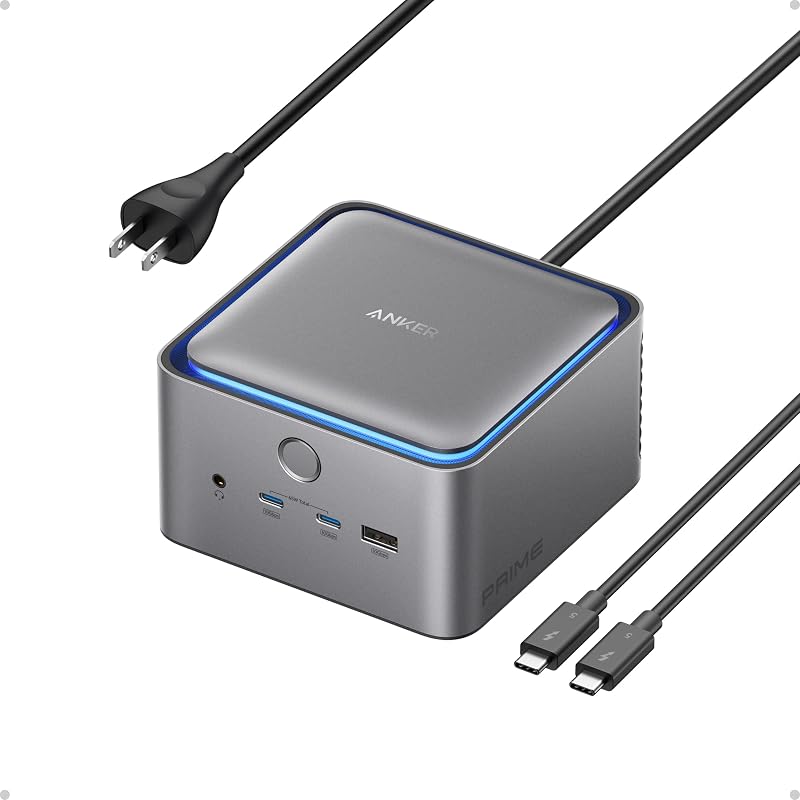
Designed for cutting-edge workstation environments, the Anker Prime TB5 Docking Station incorporates advanced Thunderbolt 5 architecture to handle bandwidth-intensive tasks. This 14-in-1 desktop hub features an upstream Thunderbolt 5 port delivering up to 140W of Power Delivery 3.1 charging, which easily satisfies the power appetites of heavy workstation laptops. File transfers operate at unprecedented speeds, enabling users to move a massive 150GB file in approximately 25 seconds over the Thunderbolt 5 connection. Those planning advanced multi-machine workstations can examine our anker thunderbolt dock overview to see how high-bandwidth protocols redefine workspace cable management.
Video output flexibility is a standout attribute of the anker prime tb5 docking station. The unit accommodates one HDMI 2.1 or DisplayPort 2.1 video connection alongside two downstream Thunderbolt 5 video ports. For single-display setups, it outputs up to 8K resolution at 60Hz, while compatible Thunderbolt 5 Windows laptops can drive dual 8K displays simultaneously at 60Hz. The dock also supports MacBooks powered by Apple silicon, including M4 Standard, Pro, and Max chips, as well as M1, M2, and M3 Pro and Max variants running Mac OS 15 Sequoia or newer. Active internal cooling keeps the 2.4-pound desktop unit operating at safe temperatures under sustained workloads.
Connectivity extends to two front-facing USB-C ports that share a combined 45W of charging power, three USB-A ports for legacy peripherals, an integrated 2.5Gbps Ethernet jack, SD and TF card slots, and an audio jack. The dock includes an AC input, a 6-foot AC power cable, and a 3.3-foot Thunderbolt 5 host cable. It is ideal for video editors, 3D artists, and engineers who demand uncompromising display fidelity and maximum data transfer bandwidth.
- Thunderbolt 5 upstream connection supporting up to 140W Power Delivery 3.1 laptop charging
- Extreme video capabilities supporting dual 8K at 60Hz displays on compatible Windows systems
- High-throughput data speeds capable of transferring 150GB in approximately 25 seconds
- Comprehensive 14-in-1 layout with 2.5Gbps Ethernet, downstream TB5 ports, and active cooling
03 Anker Nano Laptop Docking Station

Best for: Hybrid workers switching desk and travel
Pros
- Detachable 6-in-1 travel hub
- Triple monitor flexibility
- 140W power adapter included
Cons
- Mirrors only on macOS
- Requires laptop connection for power
The Anker Nano Laptop Docking Station introduces an ingenious detachable 2-in-1 form factor that bridges the gap between home workstations and mobile computing. At its core, the product functions as a 13-in-1 desktop station powered by an included 140W desktop power adapter that supplies up to 100W of clean Power Delivery to your laptop. When you need to leave the desk, a 6-in-1 portable hub detaches directly from the base, allowing you to take essential ports on the road without unplugging your entire peripheral arrangement. This portable segment acts similarly to a standalone anker 6 in 1 usb c hub for meetings or remote travel.
Display expansion is versatile, featuring two HDMI ports and one DisplayPort connection. The anker nano laptop docking station can push a single monitor at 4K at 60Hz, dual screens at 2K at 60Hz, or triple displays at 1080p at 60Hz. This flexibility makes it an attractive choice for financial traders, data analysts, and administrative managers who keep multiple spreadsheets and dashboards visible. Like many USB-C hubs using DisplayPort Alt Mode, macOS mirrors external displays identically, making independent extended multi-monitor functionality exclusive to Windows machines.
Data throughput and peripheral connections are robust, offering one 10Gbps USB-C data port, one 5Gbps USB-C data port, three USB-A ports, a Gigabit Ethernet port, a 3.5mm audio jack, and SD/TF card readers. The dock requires a laptop connection via the upstream port to activate the blue indicator light strip and functional ports. Hybrid professionals who alternate between home desk multi-monitor setups and mobile road assignments will find this dock uniquely matched to their daily habits.
- Detachable 2-in-1 architecture combining a 13-in-1 desk dock with a portable 6-in-1 travel hub
- Triple display capability driving two HDMI and one DisplayPort monitor up to 1080p at 60Hz
- Up to 100W laptop charging supported by an included 140W dedicated power adapter
- High-speed connectivity including a 10Gbps USB-C data port, Gigabit Ethernet, and card slots
04 Anker Prime Docking Station
Best for: High-wattage multi-device desktop charging
Pros
- 160W total charging power
- Ten total USB ports
- 10Gbps data throughput
Cons
- Dual display capped at 2K
- No 5120×1440 ultrawide support

Best for: Windows users demanding triple 4K monitors
Pros
- DisplayLink triple 4K output
- Real-time smart status display
- Dual 100W front USB-C ports
Cons
- Requires DisplayLink driver install
- DRM video playback limitations
Built around the advanced DisplayLink DL7400 chipset, this version of the Anker Prime Docking Station is engineered specifically for Windows power users requiring multi-monitor configurations without native GPU limitations. Unlike standard DP Alt Mode docks that reduce resolution as displays multiply, this anker displaylink dock powers up to three external 4K monitors simultaneously using its two HDMI ports and single DisplayPort. To achieve this triple 4K output on Windows 10 or 11, installing the latest DisplayLink driver is mandatory. Users streaming protected DRM video through web browsers should note that disabling hardware acceleration in browser settings prevents the black screen issue common to DisplayLink platforms.
Power management on this 14-in-1 unit is substantial. Backed by a 160W system budget, the dock features a 140W 10Gbps USB-C upstream port that keeps high-performance laptops fully charged. On the front panel, two 10Gbps USB-C ports provide up to 100W of charging power each, while a third USB-C port delivers 100W at 5Gbps data speeds. Note that the listing specifies front USB-C ports do not support media display for portable USB-C monitors. A built-in smart display provides real-time readouts of charging wattage, display performance, fan cooling mode, and operational settings, backed internally by active fan cooling and ActiveShield 3.0 thermal regulation.
Peripheral accommodation includes two 5Gbps USB-A ports, one 480Mbps USB-A port for input peripherals, a 2.5Gbps high-speed Ethernet jack, a headphone and mic combo audio jack, and SD/microSD slots. Enclosed in a phantom gray finish weighing 834.1 grams, this anker triple display docking station is the ultimate visual command center for multi-screen Windows desk setups.
- Triple 4K external display capability driven by DisplayLink DL7400 software integration
- Smart front-panel display delivering real-time charging wattage and cooling fan diagnostics
- 140W upstream laptop charging paired with two front 100W high-speed USB-C charging ports
- High-performance connectivity featuring 2.5Gbps Ethernet and ActiveShield 3.0 temperature safety
05 Anker Laptop Docking Station
The Anker Laptop Docking Station provides a dependable, all-in-one desktop expansion solution utilizing an upright form factor. Measuring 4.9 by 3.5 by 1.6 inches and weighing 13.12 ounces, its vertical profile minimizes desk footprint, preventing clutter near keyboard trays and monitor stands. Unlike bus-powered hubs, it includes a dedicated 135W DC power adapter out of the box, ensuring that connecting power-hungry devices does not cause peripheral drops or screen flickering. It delivers up to 85W of sustained charging to the host computer while simultaneously pushing 18W Power Delivery to a mobile phone via a secondary front USB-C port.
Display expansion leverages Multi-Stream Transport (MST) to drive up to three external displays at 1080p at 60Hz across two HDMI ports and one DisplayPort, or a single monitor at 4K at 60Hz. Extended multi-display functionality operates seamlessly across Windows 10, Windows 11, and ChromeOS machines equipped with full-functional USB-C, USB4, or Thunderbolt connections. Users interested in Apple setups should review our anker mac dock comparison, as macOS limits connected external monitors to mirror mode when routing video over standard USB-C MST hardware.
Data handling is comprehensive, providing a 10Gbps USB-C data port, three 5Gbps USB-A ports for thumb drives and peripherals, an RJ45 Gigabit Ethernet port, 3.5mm audio input/output, and dual SD/microSD card slots reading up to 104 MB/s. Backed by an 18-month warranty, this dock represents an optimal balance of vertical space efficiency, dedicated power delivery, and multi-monitor utility for standard corporate desks.
- Triple display expansion supporting up to three 1080p at 60Hz screens or a single 4K at 60Hz monitor
- Dedicated 135W AC power adapter providing simultaneous 85W laptop and 18W phone charging
- Compact vertical enclosure optimizing valuable desk surface area
- 13-port functional array including 10Gbps USB-C data, Gigabit Ethernet, and card slots
06 Anker Prime Docking Station
For desks packed with mobile devices, tablets, and high-wattage computing hardware, this alternative configuration of the Anker Prime Docking Station serves as a massive desktop charging hub. It delivers an impressive 160W total power envelope, allowing users to charge up to four devices simultaneously. Three independent USB-C ports can each output up to 100W maximum, supported by a 12W USB-A port. This enables power users to run their primary laptop while fast-charging secondary devices such as power banks, tablets, and smartphones without needing multiple separate wall bricks.
Display handling on this model focuses on dual-screen setups through two HDMI ports. When paired with a laptop supporting DisplayPort 1.4, it drives two external displays at up to 2K resolution at 60Hz. Connecting to a DisplayPort 1.2 host caps dual display output at 1080p at 60Hz. The manufacturer listing notes that this model does not support 5120×1440 ultrawide monitors. For macOS laptops, both external monitors mirror the exact same display output, and the dock is explicitly not compatible with Linux systems.
Managing data flow across complex workflows is straightforward thanks to ten total USB ports and rapid 10Gbps synchronization speeds. The plastic gray enclosure weighs 1.28 kilograms, giving it a stable presence that remains planted on your desk even when multiple stiff monitor cables are attached. Power users looking to replace multiple high-wattage wall chargers while retaining dual-screen productivity will appreciate this model’s high-capacity power management.
- High-output 160W power architecture charging up to four devices simultaneously
- Dual HDMI video ports supporting dual screens up to 2K at 60Hz on DP 1.4 machines
- Expansive 10-USB-port hub configuration supporting 10Gbps data transfer
- Heavyweight 1.28kg desk-stabilizing build preventing slippage under heavy cable load
What Sets These Models Apart
| Model | Total Ports | Max Monitor Support | Host Power Delivery | Power Source |
|---|---|---|---|---|
| Anker Laptop Docking Station Dual Monitor | 8 | Dual 4K@30Hz / Single 4K@60Hz | Up to 85W | Pass-through (100W PD charger required) |
| Anker Prime TB5 Docking Station | 14 | Dual 8K@60Hz / Single 8K@60Hz | Up to 140W | Dedicated AC Input (Cable included) |
| Anker Nano Laptop Docking Station | 13 | Triple 1080p@60Hz / Single 4K@60Hz | Up to 100W | Included 140W Power Adapter |
| Anker Prime Docking Station (DisplayLink) | 14 | Triple 4K@60Hz | Up to 140W | Dedicated AC Input (160W System) |
| Anker Laptop Docking Station | 13 | Triple 1080p@60Hz / Single 4K@60Hz | Up to 85W | Included 135W Power Adapter |
| Anker Prime Docking Station (160W Charging) | 14 | Dual 2K@60Hz / Dual 1080p@60Hz | Up to 100W per port (160W total) | Included Desktop Power Supply |
Buying Tips for Anker Docking Stations
Before selecting a hub from the best anker docking stations, evaluate the display communication protocols supported by your laptop and operating system. Windows laptops equipped with DisplayPort 1.4 or Thunderbolt interfaces natively support Multi-Stream Transport (MST), which allows video signals to split across multiple external monitors for an extended desktop. In contrast, macOS does not support MST over standard USB-C connections. Connecting a standard non-Thunderbolt dock to an Apple computer results in mirrored external displays. If you run a Mac and require multiple independent external displays, you must choose either a true Thunderbolt dock like the Anker Prime TB5 or a driver-assisted DisplayLink dock.
Examine the power delivery architecture to match your desk requirements. Bus-powered and pass-through hubs, such as the Anker 8-in-1 dual monitor dock, require you to supply your own high-wattage USB-C wall charger to route power to the laptop. While this reduces carrying weight for commuters, it ties up a secondary charger. Fully powered desktop docks include dedicated 135W, 140W, or integrated AC power supplies. These standalone stations supply consistent wattage to power-hungry laptops while preventing peripheral disconnects caused by sudden power drops when plugging in phones or external hard drives.
Finally, inspect data throughput and network connectivity based on your daily workload. Standard USB-A ports capped at 5Gbps or 480Mbps work well for mice, keyboards, and basic office printers. However, creative professionals moving large video files, databases, or high-resolution photography will benefit substantially from docks offering 10Gbps USB-C ports or 80Gbps to 120Gbps Thunderbolt 5 connections. For network reliability, while standard Gigabit Ethernet suffices for web browsing, stations offering 2.5Gbps Ethernet provide the low-latency, high-bandwidth connection essential for local network-attached storage (NAS) workflows and gigabit-tier internet packages.
FAQ
Can an Anker docking station support multiple extended displays on a MacBook?
It depends on the docking station’s underlying technology. Standard USB-C docks that utilize DisplayPort Multi-Stream Transport (MST) cannot extend independent displays on macOS; external monitors will simply mirror each other. To achieve multiple extended screens on a Mac, you must select either a Thunderbolt-based dock like the Anker Prime TB5 Docking Station or install background drivers for a DisplayLink-enabled dock like the Anker Prime DL7400 model.
What is the difference between pass-through charging and dedicated dock power?
Pass-through charging docks do not come with their own power supply. Instead, they feature a USB-C Power Delivery input port where you plug in your own laptop wall adapter, reserving a portion of that power for the dock while passing up to 85W to your computer. Docks with dedicated power include their own high-wattage AC power adapter or power cord, supplying consistent host charging and continuous peripheral power without requiring a separate charger.
Why does the DisplayLink dock require driver software to operate?
DisplayLink technology compresses video data and transmits it across standard USB data channels rather than relying entirely on the computer’s native DisplayPort Alt Mode video bus. Because of this, the host computer requires DisplayLink driver software to process the video stream, enabling systems to bypass native monitor quantity limitations and drive up to three 4K monitors simultaneously.
Do all Anker docks work with Linux computers?
No, operating system compatibility varies significantly across models. Several models, including the Anker Laptop Docking Station Dual Monitor and the 160W Anker Prime Docking Station, explicitly state in their technical specifications that Linux is not supported. Users running Linux distributions should verify kernel compatibility and protocol requirements before purchasing.
Can I use a Thunderbolt 5 dock with a Thunderbolt 4 or USB4 laptop?
Yes, Thunderbolt 5 is backward compatible with Thunderbolt 4, Thunderbolt 3, and USB4 host systems. When connected to an older or lower-spec port, the dock operates according to the maximum bandwidth and display limits supported by the host machine’s port specifications.