As Amazon Associates, we earn from qualifying purchases. This means we may receive a small commission at no extra cost to you if you click through and make a purchase.
As an Amazon Associate we earn from qualifying purchases. Links on this page are affiliate links.
Finding the best studio headphones under $300 requires looking past marketing claims. We compared 9 models using only their published specifications. The beyerdynamic DT 700 PRO X Closed-Back leads the list. Its 12.3-ounce weight and closed-back design provide reliable isolation for tracking vocals and instruments. These picks are ranked strictly by the data listed on each product page. You will see how impedance, driver type, and connection style affect your workflow. This guide helps you decide which headphones match your specific studio needs.
Choose wired for studio isolation
Most picks here are wireless in-ear monitors. The top wired option is the beyerdynamic DT 700 PRO X. Its closed-back design offers reliable isolation for tracking. Wireless models suit live monitoring. Select wired headphones for precise studio mixing. Choose wireless systems for stage performance. Your workflow determines the best connection type.
| # | Product | Best for | Price |
|---|---|---|---|
| 1 | beyerdynamic DT 700 PRO X Closed-Back Best overall | Studio recording and monitoring with closed-back isolation | |
| 2 | Xvive U4R2 Wireless IEM System Best premium | small venue wireless monitoring | |
| 3 | Xvive U45 Wireless IEM System Best budget | musicians needing reliable mono monitoring | |
| 4 | Xvive U45 Wireless IEM System Also great | Solo musicians needing mono wireless monitoring | |
| 5 | Xvive U45 Wireless IEM System Also great | live performance monitoring | |
| 6 | Phenyx Pro PTM-22-2B Mono IEM System Also great | Dual mono wireless monitoring | |
| 7 | Phenyx Pro PTM-10 Stereo Wireless IEM System Best stereo | Stereo wireless monitoring with 900MHz stability | |
| 8 | MICNAUX Mono IEM System 8 Bodypacks Also great | group live monitoring setups | |
| 9 | Fostex T50RPmk4CL Planar Magnetic Headphones Also great | Studio vocal tracking and monitoring |
The best fit for you
- You need reliable isolation for studio recording – beyerdynamic DT 700 PRO X Closed-Back – The closed-back design provides the isolation needed for tracking vocals and instruments.
- You want stereo monitoring without interference – Phenyx Pro PTM-10 Stereo Wireless IEM System – The 900MHz band offers stability without the interference common to 2.4GHz systems.
- You need a compact wireless solution – Xvive U4R2 Wireless IEM System – This system includes dual receivers for shared monitoring in a compact form.
- You require high-resolution audio precision – Fostex T50RPmk4CL Planar Magnetic Headphones – The planar magnetic drivers deliver the precision engineers prioritize for vocal tracking.

beyerdynamic DT 700 PRO X Closed-Back
Best for: Studio recording and monitoring with closed-back isolation
- Back Design
- Closed-Back
- Impedance
- 48-ohm
- Detachable Cable
- Detachable
- Use
- Studio, Mixing
- Dimensions
- 19.7 × 19.7 × 11 inches
- Weight
- 12.3 ounces
The Beyerdynamic DT 700 PRO X is a closed-back studio headphone designed for recording and monitoring. It features the Stellar.45 driver for precise sound at any level. With a 48-ohm impedance, it plugs directly into interfaces, laptops, or consoles without needing a dedicated amp. The package includes detachable 1.8m and 3m mini-XLR cables, allowing you to switch between desk and studio setups easily. It weighs 12.3 ounces and is made in Germany.
- 48-ohm drive impedance allows direct connection to sources without an amp
- Stellar.45 driver delivers high-resolution, precise studio sound
- Closed-back design provides isolation for tracking vocals and instruments
- Includes two detachable mini-XLR cables (1.8m and 3m)
- 12.3-ounce weight is heavier than typical in-ear monitor systems on this list
- Closed-back design limits the natural soundstage compared to open-back alternatives
- Uses proprietary mini-XLR connectors instead of standard 3.5mm or 6.35mm jacks
- You need closed-back isolation to prevent bleed during recording sessions
- You want headphones that drive easily from laptop or interface outputs
- You prefer detachable cables for easy replacement in a studio environment
- You require open-back headphones for a wider, more natural soundstage
- You prefer lightweight in-ear monitors for long-term wearing comfort
- You need standard 3.5mm or 6.35mm cable connections for immediate use
Verdict: Beyerdynamic DT 700 PRO X Closed-Back Studio Headphones suit engineers who need reliable isolation and easy driveability for tracking vocals and instruments. The included cables and low impedance make it a practical tool for studio workflows.

Xvive U4R2 Wireless IEM System
Best for: small venue wireless monitoring
- Form Factor
- In-Ear Monitor
- Connection Type
- 2.4GHz Wireless
- Features
- Wireless System
- Use
- Studio, Musicians
- Dimensions
- 4 × 1 × 1 inches
- Weight
- 4 ounces
The Xvive U4R2 is a wireless in-ear monitor system designed for studio and live musician use. It operates on a 2.4GHz frequency with a 90-foot working range and less than 5ms latency. The set includes two receivers and one transmitter, offering 6 channels for simultaneous broadcast. Battery life reaches 5 hours. This system suits performers needing reliable wireless audio in small venues.
- 2.4GHz wireless connection for global use
- 90-foot working range for stage performance
- Less than 5ms latency for distraction-free audio
- Includes two receivers and one transmitter
- 6 channels for simultaneous broadcast
- 5-hour battery life limits long sessions
- Single transmitter restricts multi-source input
- 2.4GHz frequency may face interference
- You need a wireless IEM system for small venues
- You require low latency for live performance
- You want a system with two receivers
- You need a 5.8GHz system for less interference
- You require more than 5 hours of battery
- You prefer wired connections for reliability
Verdict: The Xvive U4R2 Wireless IEM System fits musicians who need a compact wireless solution with low latency for small stage setups. Its dual receiver setup allows for shared monitoring, making it ideal for duo performances.

Xvive U45 Wireless IEM System
Best for: musicians needing reliable mono monitoring
- Form Factor
- In-Ear Monitor
- Connection Type
- 5.8 GHz
- Features
- Wireless System
- Use
- Studio, Musicians
- Dimensions
- 3.8 × 3 × 3 inches
The Xvive U45 is a wireless in-ear monitor system designed for studio and live use. It operates on the 5.8 GHz band with true diversity to maintain a solid RF connection up to 100 feet. The system delivers high-resolution 24-bit/48kHz audio with a 20Hz to 20kHz frequency response. You get 5 hours of battery life and support for simultaneous charging via USB-C. This setup suits musicians needing reliable, interference-free monitoring.
- 5.8 GHz true diversity wireless connection
- 100 ft / 30.5 m operating range
- 24-bit/48kHz high-resolution audio output
- 110 dB signal-to-noise ratio
- USB-C charging with 10-minute quick charge feature
- 5 hours of battery life is limited for long sessions
- Mono configuration limits stereo separation compared to stereo systems
- 3.8 inches length adds bulk to the bodypack
- You need a reliable wireless connection for stage or studio monitoring
- You prefer USB-C charging for convenience
- You want to avoid interference from other wireless devices
- You require a stereo monitoring experience
- You need more than 5 hours of continuous playback
- You prefer wired connections for zero latency
Verdict: Xvive U45 Wireless IEM System offers a stable 5.8 GHz connection for musicians who prioritize reliability over battery longevity. It fits users who need mono monitoring with quick charging capabilities.

Xvive U45 Wireless IEM System
Best for: Solo musicians needing mono wireless monitoring
- Form Factor
- In-Ear Monitor
- Connection Type
- 5.8 GHz
- Features
- Wireless System
- Use
- Studio, Musicians
- Dimensions
- 3.8 × 3 × 3 inches
- Weight
- 13.1 ounces
The Xvive U45 is a wireless in-ear monitor system designed for musicians and studio use. It operates on the 5.8 GHz band with true diversity reception to maintain a stable connection. The system supports 24-bit/48 kHz audio with a 20 Hz–20 kHz frequency response. You get less than 5 ms latency and an 110 dB signal-to-noise ratio for clear monitoring. It includes a smart channel scan to avoid interference and supports up to six simultaneous channels for multi-performer setups.
- 5.8 GHz true diversity wireless transmission
- 24-bit/48 kHz high-resolution audio
- Less than 5 ms latency
- 110 dB signal-to-noise ratio
- Supports up to six simultaneous channels
- Limited to mono audio output
- Includes only one bodypack receiver
- You need reliable wireless monitoring for live performance
- You require low latency for natural response
- You are setting up a multi-performer stage
- You need stereo monitoring
- You require multiple receivers in the box
- You prefer wired connections
Verdict: The Xvive U45 5.8GHz Wireless IEM fits musicians who need stable, low-latency wireless monitoring for live or studio use. It is ideal for solo performers or small bands needing a single, reliable channel.
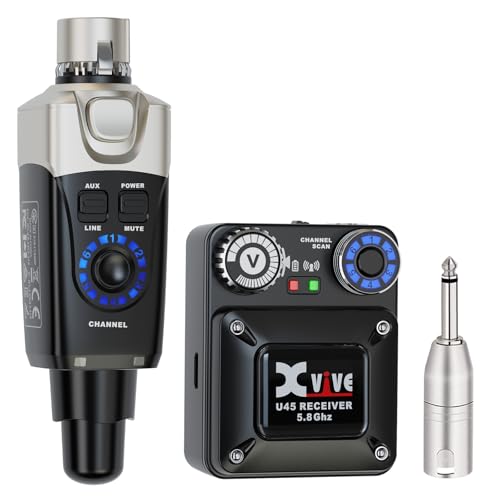
Xvive U45 Wireless IEM System
Best for: live performance monitoring
- Form Factor
- In-Ear Monitor
- Connection Type
- 5.8GHz
- Features
- Wireless System
- Use
- Studio, Musicians
- Color
- Black
This Xvive U45 system provides wireless in-ear monitoring for musicians and studio use. It operates on the 5.8GHz frequency with auto channel scanning to reduce interference. You get up to 100 feet of range and less than 5ms latency for seamless performance. The system includes rechargeable transmitters and receivers with 5 hours of battery life. It is a practical solution for live monitoring where stability and range matter.
- 5.8GHz frequency for reduced interference
- Up to 100ft wireless range
- Less than 5ms latency
- Auto channel scan for stability
- 5 hours of battery life
- 5 hours of battery life is limited for long sessions
- In-ear monitor type offers less isolation than over-ear studio headphones
- You need reliable wireless monitoring for live performances
- You require low latency for precise timing
- You want a system with auto channel scanning
- You prefer over-ear headphones for studio mixing
- You need all-day battery life without recharging
- You are looking for high-fidelity audio reproduction
Verdict: Xvive U45 Wireless In-Ear Monitor System suits musicians who need stable, low-latency wireless monitoring for live sets rather than studio mixing.

Phenyx Pro PTM-22-2B Mono IEM System
Best for: Dual mono wireless monitoring
- Form Factor
- In-Ear Monitor
- Connection Type
- UHF, Wireless
- Features
- Wireless System
- Use
- Studio, Musicians
- Color
- Black
- Ear Style
- Mono
This is a mono wireless in-ear monitor system designed for studio and live musician use. It includes two bodypack receivers and one metal transmitter. The system offers 100 selectable frequencies across dual channels to reduce interference. You get dependable wireless range for stage movement. The package includes earphones, a rackmount kit, and a carry case. It fits performers needing clear audio monitoring without cables.
- Dual-channel UHF operation with 100 selectable frequencies
- Includes two bodypack receivers for simultaneous use
- Rugged metal transmitter with LCD display
- Comprehensive kit with rackmount and carry case
- Mono audio output limits stereo separation
- Large transmitter height of 18.5 inches
- Single size option for the dual receiver set
- You need reliable wireless monitoring for live rehearsals
- You want to monitor with a partner using dual receivers
- You require interference reduction in crowded RF environments
- You require stereo sound separation
- You need a compact single-receiver setup
- You prefer wired in-ear connections
Verdict: Phenyx Pro PTM-22-2B-900-MX Dual IEM System suits musicians who need dual monitoring in mono. It delivers stable wireless performance for stage use.

Phenyx Pro PTM-10 Stereo Wireless IEM System
Best for: Stereo wireless monitoring with 900MHz stability
- Form Factor
- In-Ear Monitor
- Connection Type
- UHF
- Features
- Wireless System
- Use
- Studio, Mixing, Musicians
- Color
- Black
- Ear Style
- Stereo
The Phenyx Pro PTM-10 is a wireless in-ear monitor system designed for studio and live use. It operates on the 900MHz frequency band to reduce congestion and offers 89 tunable frequencies for multi-system setups. The system includes two bodypack receivers and supports stereo or mono modes. Its metal transmitter and 160ft range provide reliable coverage for performers who need distraction-free monitoring in professional environments.
- Stereo and mono mode selection for flexible monitoring
- 900MHz frequency band with 89 tunable frequencies
- 160ft reliable wireless coverage range
- Metal transmitter body for durability
- Includes only two bodypack receivers per system
- Requires four AA batteries for operation
- You need true stereo monitoring for spatial clarity
- You perform in environments with 2.4GHz congestion
- You require a durable metal transmitter unit
- You need more than two simultaneous receivers
- You prefer wired connections over wireless systems
- You want a single receiver only
Verdict: Phenyx Pro PTM-10 Stereo Wireless IEM System fits musicians and speakers who need reliable stereo monitoring without 2.4GHz interference. It suits users who value the stability of the 900MHz band and the durability of a metal transmitter.

MICNAUX Mono IEM System 8 Bodypacks
Best for: group live monitoring setups
- Form Factor
- In-Ear Monitor
- Connection Type
- UHF, Wireless
- Features
- Wireless System
- Use
- Studio, Musicians
- Color
- Black
- Ear Style
- Mono
This MICNAUX mono in-ear monitor system includes eight bodypack receivers for group use. It operates on the 520–580 MHz UHF band with a 32MHz frequency range. You get stable connections up to 330 feet and one-touch IR sync for quick setup. The metal transmitter and ABS receivers support live stages or studio rehearsals. It suits musicians needing reliable, cable-free monitoring for multiple performers.
- Includes 8 bodypack receivers for group monitoring
- UHF band with PLL technology for stable signal
- One-touch IR sync for fast pairing
- 330-foot range in open areas
- Metal transmitter construction for durability
- Mono audio output limits stereo imaging
- Only one transmitter included for single source
- ABS plastic receivers are less robust than metal
- You need monitoring for a group of performers
- You require a stable UHF connection on stage
- You want quick IR sync setup for rehearsals
- You need stereo sound for critical mixing
- You only need a single earpiece
- You prefer wired connections for zero latency
Verdict: MICNAUX Mono IEM System 8 Bodypacks provides essential group monitoring for live performances. It fits bands or worship teams needing reliable wireless tracking for multiple members.

Fostex T50RPmk4CL Planar Magnetic Headphones
Best for: Studio vocal tracking and monitoring
- Back Design
- Closed-Back
- Impedance
- 28Ω
- Driver Type
- Planar Magnetic
- Color
- Black
The Fostex T50RPmk4CL is a closed-back studio headphone featuring a planar magnetic driver. It offers a frequency response from 10Hz to 40kHz and 28 ohms of impedance. The design minimizes sound leakage, making it suitable for vocal tracking. Weighing 330g, it uses low-rebound earpads for comfort during long sessions. This model suits engineers who need precise monitoring with minimal external noise interference.
- Planar magnetic driver for low-distortion sound
- Closed-back design reduces sound leakage
- Wide 10Hz–40kHz frequency response
- Dual cable ports for flexible connectivity
- 330g weight is heavier than many standard studio cans
- 28 ohm impedance requires adequate amplification
- Closed-back design may cause ear fatigue for some users
- You need precise monitoring with minimal sound leakage
- You prefer planar magnetic driver accuracy
- You work in a controlled studio environment
- You need ultra-lightweight headphones for all-day wear
- You require wireless connectivity options
- You prefer open-back soundstage for mixing
Verdict: Fostex T50RPmk4CL Planar Magnetic Headphones delivers high-resolution audio for engineers who prioritize sound isolation and driver precision over lightweight comfort.
Specifications side by side
| Spec | beyerdynamic DT 700 PRO X Closed-Back | Xvive U4R2 Wireless IEM System | Xvive U45 Wireless IEM System | Xvive U45 Wireless IEM System | Xvive U45 Wireless IEM System | Phenyx Pro PTM-22-2B Mono IEM System | Phenyx Pro PTM-10 Stereo Wireless IEM System | MICNAUX Mono IEM System 8 Bodypacks | Fostex T50RPmk4CL Planar Magnetic Headphones |
|---|---|---|---|---|---|---|---|---|---|
| Form Factor | – | In-Ear Monitor | In-Ear Monitor | In-Ear Monitor | In-Ear Monitor | In-Ear Monitor | In-Ear Monitor | In-Ear Monitor | – |
| Back Design | Closed-Back | – | – | – | – | – | – | – | Closed-Back |
| Impedance | 48-ohm | – | – | – | – | – | – | – | 28Ω |
| Connection Type | – | 2.4GHz Wireless | 5.8 GHz | 5.8 GHz | 5.8GHz | UHF, Wireless | UHF | UHF, Wireless | – |
| Driver Type | – | – | – | – | – | – | – | – | Planar Magnetic |
| Detachable Cable | Detachable | – | – | – | – | – | – | – | – |
| Connection | – | Wireless | Wireless | Wireless | Wireless | Wireless | Wireless | Wireless | – |
| Features | – | Wireless System | Wireless System | Wireless System | Wireless System | Wireless System | Wireless System | Wireless System | – |
| Use | Studio, Mixing | Studio, Musicians | Studio, Musicians | Studio, Musicians | Studio, Musicians | Studio, Musicians | Studio, Mixing, Musicians | Studio, Musicians | – |
| Color | Black with Grey | U4R2 Two Receivers and One Transmitter | U45 BLACK | U45 | Black | Black | Black | Black | Black |
| Type | – | In-Ear Monitor | In-Ear Monitor | In-Ear Monitor | In-Ear Monitor | In-Ear Monitor | In-Ear Monitor | In-Ear Monitor | – |
| Ear Style | – | – | – | – | – | Mono | Stereo | Mono | – |
| Dimensions | 19.7 × 19.7 × 11 inches | 4 × 1 × 1 inches | 3.8 × 3 × 3 inches | 3.8 × 3 × 3 inches | – | 13.2 × 2.56 × 18.5 inches | 11.1 × 7.8 × 4.41 inches | 18.9 × 3.85 × 1.9 inches | – |
| Weight | 12.3 ounces | 4 ounces | – | 13.1 ounces | – | – | – | – | – |
| Size | One Size | U4R2 | One Size | – | U45 | 2 receiver+1 transmitter | 2 receivers+1 transmitter | 8 bodypack | – |
| Model | 737704 | U4,PT624046 | U45 BLACK | U45 | U45,PT624046 | PTM-22-2B-900-MX | PTM-10 | MU-8000 | T50RPmk4CL |
If you want general listening options rather than studio hardware, compare best headphones under 300 by their documented specs.
How to choose studio headphones
Check the back design
The back design determines how much sound leaks in and out. Closed-back models like the beyerdynamic DT 700 PRO X provide isolation for tracking vocals. This prevents sound from bleeding into microphones. Open-back designs offer a wider soundstage but lack isolation. For studio recording, closed-back is often the safer choice. It keeps your mix clean. Wireless in-ear monitors also isolate sound by sitting directly in the ear canal. This blocks out stage noise effectively for live monitoring tasks.
Select the connection type
Connection type affects your workflow flexibility. Wired headphones like the DT 700 PRO X offer zero latency and consistent power. This is critical for precise studio mixing. Wireless systems like the Xvive U4R2 or Phenyx Pro PTM-10 allow freedom of movement. They use specific frequencies like 5.8 GHz or 900 MHz for stability. Choose wired for stationary studio work. Choose wireless for live performance monitoring where mobility is essential. Both types serve distinct professional needs.
Consider the driver type
Driver technology shapes the audio quality. The Fostex T50RPmk4CL uses planar magnetic drivers for high-resolution audio. This type delivers precise detail and fast response times. It suits engineers who prioritize sound isolation and driver precision. Other models in this list use standard dynamic drivers within wireless IEMs. These are optimized for monitoring rather than critical listening. Check the driver type if you need detailed frequency response. It matters most for mixing and mastering tasks in the studio.
Evaluate the fit and weight
Comfort is vital for long sessions. The beyerdynamic DT 700 PRO X weighs 12.3 ounces. This weight provides a secure fit for studio use. Wireless IEMs are lighter but sit in the ear. The Xvive U45 weighs very little, making it comfortable for live sets. Consider how you wear them. Over-ear headphones require headband comfort. In-ear monitors require ear tip fit. Choose based on your physical comfort. You need to wear them for hours without fatigue.
Match the use case
Your primary use dictates the best choice. The DT 700 PRO X is built for studio mixing and recording. It offers reliable isolation for tracking. Wireless systems like the Phenyx Pro PTM-10 are best for live performance monitoring. They provide stereo monitoring with stability. The Xvive U45 suits musicians needing reliable mono monitoring. Match the product to your environment. Studio work requires wired precision. Live work requires wireless mobility. Do not mix these use cases.
Frequently asked questions
Are in-ear monitors good for studio work?
Yes, several wireless IEM systems on this list suit studio environments. The Xvive U4R2 and U45 models are designed for musicians needing reliable monitoring. They use 5.8 GHz or 900 MHz bands to reduce interference. These systems provide stable connections for tracking vocals or instruments in controlled settings.
What is the best closed-back headphone for isolation?
The beyerdynamic DT 700 PRO X Closed-Back is the top choice for isolation. Its closed-back design prevents sound leakage, which is critical for tracking. The 12.3-ounce weight and included cables make it practical for studio workflows. It offers reliable performance for engineers who need precise monitoring without external noise.
Do I need stereo or mono monitoring?
It depends on your setup. The Phenyx Pro PTM-10 offers stereo monitoring for accurate soundstage representation. The Xvive U45 and Phenyx Pro PTM-22-2B provide mono options for simpler signal paths. Stereo is ideal for mixing, while mono is often sufficient for live tracking or solo performances.
Which wireless system avoids 2.4GHz interference?
The Phenyx Pro PTM-10 uses the 900 MHz band to avoid 2.4GHz congestion. This frequency offers stability for studio and stage use. The Xvive models use 5.8 GHz, which also minimizes interference. Choosing these bands ensures a clear signal for musicians who need reliable wireless performance in busy environments.
Are planar magnetic drivers better for studio work?
The Fostex T50RPmk4CL features planar magnetic drivers for high-resolution audio. This technology provides precise sound reproduction for critical listening. The closed-back design enhances isolation during vocal tracking. Engineers who prioritize driver precision and sound clarity may find this model suitable for detailed mixing and monitoring tasks.
Can I share a wireless IEM signal?
Yes, the Xvive U4R2 includes a dual receiver setup. This allows two users to share the same monitoring signal simultaneously. It is ideal for duo performances or collaborative studio sessions. Other models like the U45 offer single-channel mono monitoring for individual performers who do not need shared audio feeds.
What weight should studio headphones be?
The beyerdynamic DT 700 PRO X weighs 12.3 ounces, providing a balanced feel for long sessions. Lighter options like the Xvive U4R2 bodypacks weigh only 4 ounces. Heavier models like the Fostex T50RPmk4CL prioritize driver precision over lightweight comfort. You should choose based on your preference for portability versus build quality.