As Amazon Associates, we earn from qualifying purchases. This means we may receive a small commission at no extra cost to you if you click through and make a purchase.
Choosing a nikon mirrorless camera full frame system requires evaluating how sensor architecture, autofocus tracking, and continuous data throughput fit into your home studio desk and daily production routines. Full-frame sensors offer distinct advantages in dynamic range, low-light clean signaling, and subject isolation, establishing an ideal foundation for video streaming, desktop product capture, and commercial photography. Selecting the right body depends heavily on whether your workspace prioritizes uncompressed video recording directly to external cards, rapid autofocus subject recognition for live presentations, or ultra-high pixel counts for detailed still capture.
This guide examines six nikon full frame mirrorless cameras, analyzing how each model handles the demands of modern desktop workflows and studio setups. Across these six options, Nikon incorporates varying sensor technologies, including conventional front-illuminated CMOS, Back-Illuminated (BSI) CMOS, partially-stacked CMOS, and fully stacked high-speed sensors. Understanding how these hardware variations influence burst speeds, thermal efficiency, buffer capacities, and video capabilities will help you identify the best body for your specific desk environment and creative assignments.
Which Nikon Full-Frame Mirrorless Cameras Should You Buy
- Nikon Z6 III: Best for fast-action hybrid creators and video producers needing high-frame-rate internal RAW capture and ultra-fast sensor readout.
- Nikon Z5 II: Best for modern desk streaming, everyday studio content creation, and automated cloud backup integration.
- Nikon Z5 II with Telephoto Zoom: Best for solo studio operators and traveling creators who require immediate wide-to-telephoto versatility from a single kit lens.
- Nikon Z 7II: Best for commercial studio photographers, fine-art still shooters, and tabletop product imaging demanding ultra-high 45.7MP detail.
- Nikon Z 8: Best for flagship commercial production studios requiring uncompromising internal 8K video, ProRes capture, and blackout-free continuous shooting.
- Nikon Z 5: Best for budget-conscious home studio operators seeking a compact entry point into full-frame still photography and desktop video.
Measure shown: Weight (lb). Every figure is the number the seller publishes on that product page — nothing on this site is measured by us. Longest bar is highlighted.
01 Nikon Z6 III

Best for: Fast-action hybrid creators and video producers
Pros
- 6K internal RAW video capture
- Bright 4000-nit 120fps viewfinder
- Partially-stacked sensor with 120fps burst
Cons
- 5MP limits extreme commercial cropping
- Generates demanding high-bitrate video files
The Nikon Z6 III represents a major leap in hybrid workspace performance, built around Nikon’s first partially-stacked 24.5MP CMOS sensor and the EXPEED 7 image processor. This sensor design accelerates readout speeds, enabling continuous electronic shutter bursts up to 120 fps and reducing rolling shutter distortion during rapid pan movements across a video desk. The camera stands out as a premier production tool, offering internal 6K/60p N-RAW recording, oversampled 4K UHD capture, 4K at 120p, and Full HD slow-motion recording at 240p, alongside Hi-Res Zoom features that extend framing options without degrading footage quality.
Workspace monitoring is remarkably crisp thanks to a 5760k-dot electronic viewfinder with a class-leading brightness output of 4000 nits and a smooth 120 fps refresh rate. Autofocus performance operates down to -10EV and employs Deep Learning technology to detect human faces covering as little as three percent of the frame, delivering a 20 percent speed improvement over its predecessor. Creators upgrading from legacy mirrorless systems or evaluating canon mirrorless cameras will appreciate how Nikon’s high-speed EXPEED 7 engine handles real-time focus calculations. The camera also supports Flexible Picture Control profiles created in NX Studio and sensor-shift image stabilization. It gives way to the Nikon Z 8 only when your studio demands internal 8K recording or 45.7MP still output.
- Partially-stacked 24.5MP CMOS sensor paired with the EXPEED 7 image processor
- Internal 6K/60p N-RAW, oversampled 4K UHD, 4K/120p, and Full HD/240p slow-motion capture
- High-brightness 4000-nit electronic viewfinder with 5760k-dot resolution and 120 fps refresh rate
- Deep Learning autofocus tracking operating down to -10EV with detection for human faces occupying 3 percent of the frame
02 Nikon Z5 II
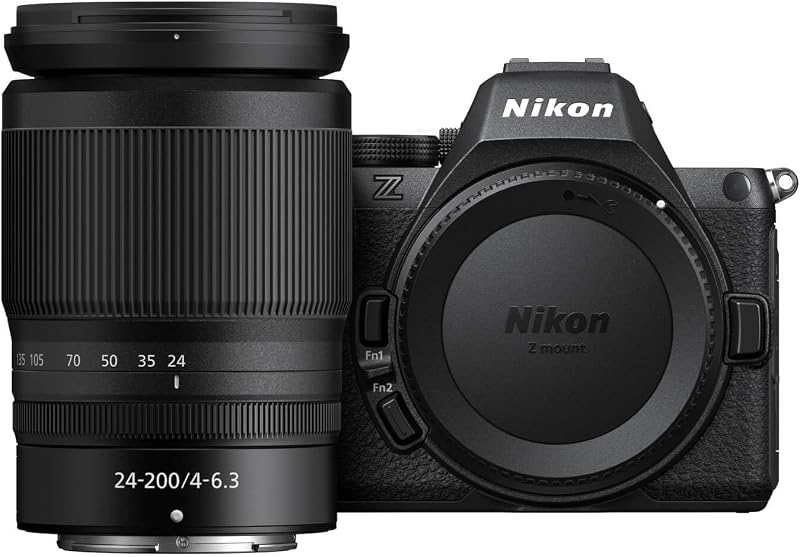
Best for: Turnkey desk and field documentary hybrid creators
Pros
- Versatile 24-200mm lens included
- In-camera 12-bit N-RAW recording
- Automated cloud backup capabilities
Cons
- Variable f/4-6.3 maximum aperture
- Larger overall lens footprint

Best for: Modern desk streaming and everyday content creation
Pros
- Direct Nikon Imaging Cloud connectivity
- Up to 7.5 stops image stabilization
- 9-subject autofocus tracking to -10EV
Cons
- 1/8000s maximum shutter speed
- Digital stabilization mode listed in specifications
The Nikon Z5 II is purpose-built for desk setups, content streamers, and creators needing modern video capabilities and automated image transfers. Featuring a 24.5MP BSI-CMOS FX-format sensor and the EXPEED 7 processing engine, this camera captures continuous bursts up to 30fps and delivers robust low-light autofocus down to -10EV. It brings high-tier autofocus tracking to everyday creators by automatically recognizing nine distinct subject types, including people, birds, dogs, cats, cars, bicycles, motorcycles, trains, and airplanes, ensuring reliable subject retention during live presentations or overhead desktop demonstrations.
A central advantage of this model within an office setup is its integration with the Nikon Imaging Cloud service, which enables automated image transfers directly to chosen cloud storage platforms, automated firmware updates, and downloadable Picture Controls without computer tethering. For handheld work, the camera offers up to 7.5 stops of built-in image stabilization and a bright 3000-nit electronic viewfinder. Video production is supported by 4K/60p capture and 12-bit in-camera N-RAW recording. The Nikon Z5 II suits content creators focused on streamlined digital distribution, giving way to the Nikon Z6 III when ultra-fast sensor readout, 120 fps bursts, or 6K RAW capture are necessary.
- 24.5MP BSI-CMOS FX-format sensor powered by the EXPEED 7 processing engine
- In-camera 12-bit N-RAW recording and high-resolution 4K/60p video capture
- Direct Nikon Imaging Cloud connectivity for automated wireless file backup and firmware updates
- Intelligent autofocus tracking 9 subject categories with low-light detection down to -10EV
03 Nikon Z5 II with Telephoto Zoom
The Nikon Z5 II with Telephoto Zoom bundles the 24.5MP Z5II camera body with the versatile NIKKOR Z 24-200mm f/4-6.3 VR lens. This complete configuration is an excellent match for home and office creators who require broad focal flexibility without cluttering their studio shelves with multiple interchangeable lenses. The 24mm wide end easily frames full desktop workstations, presenter desks, and overhead demonstration rigs, while zooming in toward 200mm lets you isolate intricate product textures, capture tight portrait b-roll, or track subjects across larger room environments.
Under the hood, the camera retains all core performance capabilities of the standalone Z5 II body, including EXPEED 7 processing, continuous shooting speeds up to 30fps, 9-subject autofocus tracking down to -10EV, and up to 7.5 stops of built-in image stabilization complemented by the lens’s optical vibration reduction. The bundle also supports direct Nikon Imaging Cloud transfers, SnapBridge wireless remote operation, and in-camera 12-bit N-RAW recording at 4K/60p. This package suits solo creators wanting an all-in-one kit out of the box, though it gives way to standalone bodies paired with wide-aperture prime lenses when maximum low-light background separation beyond f/4 is required.
- Complete production kit combining the 24.5MP Z5II body with a NIKKOR Z 24-200mm f/4-6.3 VR lens
- Versatile wide-angle to telephoto focal range suitable for desk overviews and tight product details
- Full EXPEED 7 feature set with 9-subject automatic detection and -10EV autofocus sensitivity
- In-camera 4K/60p video recording, 12-bit N-RAW capture, and Nikon Imaging Cloud integration
04 Nikon Z 7II

Best for: Commercial studio and fine-art detail photographers
Pros
- High-resolution 45.7MP imaging sensor
- Dual card slots for backup redundancy
- Clean native base sensitivity of ISO 64
Cons
- Lacks modern internal 8K recording
- Older dual-processor architecture
The Nikon Z 7II is engineered specifically for ultra-high-resolution imaging, making it a staple for commercial product photographers, print specialists, and tabletop studio setups. Equipped with a 45.7MP CMOS sensor and dual processing engines, the Z 7II resolves microscopic details on consumer goods, packaging materials, and fine art prints. Its native base sensitivity of ISO 64 maximizes dynamic range and tonal transitions, which is especially beneficial when shooting tethered under balanced studio strobe illumination or desktop LED panels.
Photographers migrating from older digital single-lens reflex platforms or researching legacy 4k dslr sony setups will find the dual processor throughput and dual card redundancy of the Z 7II remarkably dependable for commercial client shoots. The body includes dual card slots supporting one CFexpress/XQD card and one UHS-II SD card, allowing instant backup storage during live assignments. It also supports 4K UHD video at 60p, continuous USB-C power delivery for day-long studio tethering, and an optional vertical battery grip. While it excels in static commercial resolution, the Z 7II gives way to the Nikon Z 8 when high-speed stacked sensor performance, internal 8K capture, or 120 fps burst rates are necessary.
- High-resolution 45.7MP CMOS sensor with an expanded minimum sensitivity of ISO 64
- Dual card slots accepting CFexpress/XQD and UHS-II SD memory cards for workflow redundancy
- Dual processors delivering 3.3x more buffer capacity than the original Z 7 model
- Continuous USB-C power delivery and 4K UHD video recording at 60p
05 Nikon Z 8
Best for: High-end commercial and cinema production studios
Pros
- Internal 8K/60p and ProRes RAW recording
- Blackout-free 45.7MP stacked sensor
- High-speed shutter up to 1/32000s
Cons
- Substantial battery consumption during recording
- Requires large-capacity high-speed storage
The Nikon Z 8 brings flagship cinema and stills capabilities into a compact, modular body that integrates seamlessly into professional home and office production studios. Powered by a 45.7MP stacked CMOS sensor and the EXPEED 7 engine, the Z 8 eliminates physical mechanical shutter vibrations completely, utilizing a high-speed electronic shutter capable of exposures up to 1/32000 second. The stacked sensor architecture delivers a blackout-free viewfinder experience and extreme burst speeds of 20, 30, 60, and 120 fps, ensuring you never miss a split-second movement during product demonstrations or live desktop action.
On the video front, the Z 8 is a self-contained cinematic workhorse, capturing internal 12-bit 8K/60p and 4K/120p in N-RAW and ProRes RAW, alongside 10-bit ProRes 422 HQ. Deep learning autofocus combines advanced subject detection with 3D tracking down to -9EV, accurately tracking nine subject types across the frame. Portraiture and presentation workflows benefit from built-in Skin Softening and Portrait Impression Balance controls. The Z 8 is the ultimate hybrid camera in Nikon’s lineup, though creators with simpler desktop streaming needs or restricted file storage may prefer the lighter footprint and smaller file sizes of the Nikon Z6 III or Z5 II.
- 45.7MP stacked CMOS sensor featuring a silent electronic shutter reaching 1/32000s
- Internal 12-bit 8K/60p, 4K/120p, and 10-bit ProRes 422 HQ video recording
- Advanced autofocus with deep learning 3D tracking down to -9EV across 9 subject classes
- Extreme continuous shooting options supporting 20, 30, 60, and 120 fps capture
06 Nikon Z 5
Best for: Entry-level full-frame workspace still photographers
Pros
- Compact and lightweight full-frame chassis
- 5-axis in-body image stabilization
- USB power delivery for desk operation
Cons
- 4K video capture limited to 30p
- Autofocus subject tracking limited to eyes
The Nikon Z 5 serves as Nikon’s most compact full-frame interchangeable lens mirrorless camera, offering a practical entry into full-frame photography and desktop video recording. Centered around a 24.3MP full-frame CMOS sensor, it produces clean, color-accurate images with wide dynamic range and shallow depth of field. Its compact footprint makes it an easy fit on desk articulating arms, small monitor mounts, and lightweight tabletop tripods where larger camera bodies can cause mount instability.
For video and desk conferencing, the Z 5 provides 4K/30p and 1080/60p recording, an HDMI output for external capture cards, and USB power delivery that keeps the camera running continuously during long presentations or streaming sessions. Built-in 5-axis sensor-shift image stabilization ensures sharp handheld still images and steady video panning. Eye-Detection autofocus locks onto human, dog, and cat eyes reliably. While the Z 5 remains an outstanding entry-level tool for stills and basic desktop video, it yields to the newer Nikon Z5 II and Z6 III when 4K/60p, high-speed 30fps bursts, or advanced vehicle autofocus tracking are required.
- Compact and lightweight 24.3MP full-frame CMOS imaging sensor
- 5-axis sensor-shift in-body image stabilization for shake-free capture
- Eye-Detection autofocus tracking human, dog, and cat eyes across the frame
- USB power delivery support allowing continuous camera operation during desktop streaming
What Sets These Models Apart
Conducting a nikon mirrorless camera full frame comparison reveals clear divisions between sensor readout speeds, video recording codecs, autofocus capabilities, and continuous shooting throughput. The table below outlines how these six models compare across key technical specifications.
| Model | Sensor Type & Resolution | Video Recording Capabilities | Maximum Continuous Speed | Low-Light Autofocus Limit |
|---|---|---|---|---|
| Nikon Z6 III | 24.5MP Partially-Stacked CMOS | 6K/60p Internal RAW, 4K/120p | 120 fps | -10EV |
| Nikon Z5 II | 24.5MP BSI CMOS | 4K/60p, 12-bit N-RAW | 30 fps | -10EV |
| Nikon Z5 II with Telephoto Zoom | 24.5MP BSI CMOS | 4K/60p, 12-bit N-RAW | 30 fps | -10EV |
| Nikon Z 7II | 45.7MP CMOS | 4K UHD 60p | Standard continuous shooting | The listing does not specify |
| Nikon Z 8 | 45.7MP Stacked CMOS | 8K/60p, 4K/120p, ProRes RAW | 120 fps | -9EV |
| Nikon Z 5 | 24.3MP CMOS | 4K/30p, 1080/60p | Standard continuous shooting | The listing does not specify |
Buying Tips for Nikon Full-Frame Mirrorless Cameras
When selecting a camera for a home studio or office desk setup, power connectivity should be your primary consideration. Cameras supporting USB power delivery, such as the Nikon Z 5, Z5 II, Z6 III, and Z 8, can operate continuously from an external USB-C power bank or wall adapter without draining their internal batteries. This continuous power is crucial for extended live streams, lengthy remote meetings, or day-long product review shoots. Additionally, make sure your desk mounting hardware can comfortably support the combined weight of your chosen body and attached lenses.
Your sensor architecture choice should align with your production style. Traditional CMOS sensors found in models like the Nikon Z 5 and Z 7II offer exceptional dynamic range and resolution for still photography and controlled video setups. However, if your content involves fast subject movements or rapid camera pans across a studio space, partially-stacked sensors like that in the Z6 III or fully stacked sensors like that in the Z 8 drastically reduce rolling shutter artifacts and allow blackout-free monitoring during burst shooting. While photographers often evaluate third-party glass like sony fe lens systems on other mounts, Nikon’s native Z mount offers a short flange distance and wide diameter that maximize edge-to-edge optical clarity.
Finally, factor in your storage media and workflow pipeline. Recording internal 6K or 8K RAW video on the Z6 III and Z 8 generates substantial data that demands high-speed CFexpress memory cards and fast computer storage drives. For creators aiming to publish rapidly to social channels or web archives without extensive post-processing, bodies supporting the Nikon Imaging Cloud, such as the Z5 II, streamline your operations by transferring files directly to cloud storage solutions right over your local studio Wi-Fi network.
FAQ
Which Nikon mirrorless camera full frame to buy for a dedicated video desk?
For a dedicated video desk, the best nikon mirrorless for video depends on your capture requirements. The Nikon Z6 III is an outstanding hybrid option offering internal 6K/60p N-RAW recording, oversampled 4K capture, and Full HD at 240p slow motion. If your production pipeline requires commercial-grade 8K recording and ProRes 422 HQ internal capture, the Nikon Z 8 is the premier choice. For standard 4K/60p streaming and direct cloud backup, the Nikon Z5 II offers an efficient, user-friendly solution.
How do the autofocus systems differ across the Nikon Z series full frame cameras?
Autofocus capabilities vary based on the processor and sensor generation. The Nikon Z5 II, Z6 III, and Z 8 feature advanced subject recognition powered by the EXPEED 7 processor, automatically tracking up to nine subject types, including humans, pets, birds, and various vehicles. The Z6 III and Z5 II achieve focus sensitivity down to -10EV, while the Z 8 reaches -9EV with sophisticated 3D tracking. The Nikon Z 5 focuses primarily on human and animal Eye-Detection, and the Z 7II utilizes dual processors for precision eye-detection across still and video modes.
Can these Nikon full frame mirrorless cameras be powered continuously over USB during live streaming?
Yes, several models in this lineup, including the Nikon Z 5, Nikon Z5 II, Nikon Z6 III, Nikon Z 7II, and Nikon Z 8, support continuous USB power delivery and charging. Connecting a compatible USB-C power source allows you to stream, record long-form video, or conduct remote conference sessions without interruption from battery depletion.
What is the benefit of the partially-stacked sensor in the Nikon Z6 III?
The partially-stacked CMOS sensor in the Nikon Z6 III provides significantly faster circuit readout compared to standard front-illuminated or conventional BSI sensors. This accelerated readout reduces rolling shutter distortion during fast panning, supports continuous burst shooting up to 120 fps, allows high-frame-rate 6K RAW video recording, and powers a fluid 120 fps refresh rate in the 4000-nit electronic viewfinder.
How does the Nikon Z 7II compare to the Nikon Z 8 for studio product photography?
Both the Nikon Z 7II and Nikon Z 8 share a high 45.7MP resolution, making them superb choices for resolving fine textures in commercial product photography. The Z 7II provides an expanded base sensitivity of ISO 64 and dual memory card slots (CFexpress and SD) in a traditional dual-processor body. The Z 8 adds an advanced stacked sensor, an electronic shutter reaching 1/32000s, deep learning 3D autofocus tracking, and high-end internal 8K video recording, serving hybrid studios that require top-tier video alongside high-resolution stills.