As Amazon Associates, we earn from qualifying purchases. This means we may receive a small commission at no extra cost to you if you click through and make a purchase.
Selecting the right asus rog 32 inch monitor 4k oled 240hz display transforms both high-end gaming and daily desk workflows. Desktop users often struggle to find a single screen that combines uncompressed high-refresh gaming performance with the clean text rendering, uniform luminance, and neat cable management needed for full-day office work. Modern OLED displays bridge this divide by pairing instantaneous pixel response times and per-pixel dimming with workstation features like integrated USB-C power delivery, intelligent burn-in mitigation sensors, and customizable color profiles that suit productive desk setups.
This comparative guide examines six premier displays from the ASUS lineup, highlighting how their internal hardware, panel coatings, and port bandwidths align with distinct desk arrangements. By conducting this detailed asus rog 4k oled monitor comparison, you can evaluate the fundamental trade-offs between glossy and matte surfaces, standard DisplayPort versus uncompressed DisplayPort 2.1 connectivity, and full-sized 32-inch displays versus ultra-dense 27-inch panels to pinpoint the exact display that fits your daily routine.
Which ASUS 4K OLED Gaming Monitors Should You Buy
- For dual-purpose desks needing flexible refresh switching between 4K immersion and esports frame rates: ASUS ROG XG32UCWMG 32 Inch 4K.
- For clean single-cable laptop docking paired with third-generation QD-OLED performance: ASUS ROG PG32UCDM 32 Inch 4K.
- For cutting-edge workstations with high-bandwidth graphics cards and high ambient scratch resistance: ASUS ROG PG32UCDM3 32 Inch 4K.
- For content creators wanting full DisplayPort 2.1 accessory cabling and bundled creative applications: ASUS ROG PG32UCDMR 32 Inch 4K.
- For space-constrained setups prioritizing extreme pixel density and full 80Gbps bandwidth: ASUS ROG PG27UCDM 27 Inch 4K.
- For compact gaming desks that benefit from fourth-generation panel longevity and luminance stability: ASUS ROG XG27UCDMG 27 Inch 4K.
Measure shown: Weight (lb). Every figure is the number the seller publishes on that product page — nothing on this site is measured by us. Longest bar is highlighted.
01 ASUS ROG XG32UCWMG 32 Inch 4K

Best for: Dual-refresh gaming and glossy contrast setups
Pros
- Dual-mode 4K 240Hz and FHD 480Hz
- Zero-haze TrueBlack Glossy WOLED
- Neo Proximity Sensor protection
Cons
- USB-C limited to 15-watt power
- Lower laptop charging capability
The ASUS ROG XG32UCWMG 32 Inch 4K delivers a specialized visual experience centered around its TrueBlack Glossy WOLED panel. The zero-haze glass surface preserves native black levels and produces exceptionally sharp contrast, making visual assets and dark software interfaces appear vivid. Its signature operational advantage is Dual Mode display technology, which allows desk users to alternate between a native 4K resolution at 240Hz for creative tasks and a swift 1080p mode at 480Hz for competitive gaming sessions.
In a home office, the integrated Neo Proximity Sensor operates as part of the ASUS OLED Care Pro suite to protect against image retention. This sensor registers when you step away from your chair and automatically turns the screen black, eliminating passive burn-in risks caused by static spreadsheets or browser tabs. The compact base occupies minimal desk space, leaving plenty of room for oversized desk pads, external audio interfaces, or mechanical keyboards.
The display covers 99% of the DCI-P3 color space with true 10-bit depth and a factory-calibrated Delta E below 2. For connectivity, it incorporates DisplayPort 1.4 with Display Stream Compression, two HDMI 2.1 ports, and a versatile USB-C connection. While the USB-C port provides useful peripheral connectivity, its 15-watt power delivery is suited for smartphones and accessories rather than running a workstation laptop, marking where users with high-draw mobile computers might prefer one of the higher-wattage alternatives in the ROG family.
- Dual-mode capability toggling between 4K at 240Hz and FHD at 480Hz
- TrueBlack Glossy panel finish delivering zero-haze contrast
- Neo Proximity Sensor within OLED Care Pro for active presence detection
- DisplayPort 1.4, HDMI 2.1, and 15-watt USB-C connectivity
02 ASUS ROG PG32UCDM 32 Inch 4K

Best for: Creators needing reliable 90-watt laptop docking
Pros
- 90-watt USB-C power delivery
- Dolby Vision HDR support
- Graphene film thermal management
Cons
- Uses DisplayPort 1.4 with DSC
- Standard matte panel finish
The ASUS ROG PG32UCDM 32 Inch 4K is engineered around a third-generation QD-OLED panel coated in a low-reflection matte finish. This matte surface treatment diffuses harsh ambient lighting across bright offices, preventing glare without losing the punchy vibrancy produced by quantum dot color conversion. With a 1,500,000:1 contrast ratio, 1000 nits of peak brightness, and Dolby Vision support, this monitor serves equally well for professional grading and high-dynamic-range gaming.
Desk ergonomics and laptop integration are central strengths of this model. The rear I/O panel includes a USB-C port capable of 90-watt power delivery, enabling modern work laptops to receive video, data, and full battery charging through a single connection. Heat management is handled by a custom passive heatsink, specialized internal airflow channeling, and a rear graphene film layer that draws heat away from the organic substrate without relying on noisy cooling fans. When setting up an asus rog 32 inch monitor 4k oled setup, maintaining reliable thermal dissipation ensures panel longevity through back-to-back workdays.
When evaluating the asus rog pg32ucdm vs xg32ucwmg, the primary operational differences center on panel coatings and power distribution. While the XG model opts for a glossy finish and dual refresh modes with lower USB wattage, the PG32UCDM emphasizes single-cable productivity via 90W delivery and an optional uniform brightness setting that locks luminance levels to prevent distracting auto-dimming during document reading. Users who need DisplayPort 2.1 or higher structural hardness, however, may look toward the newer revisions in the line.
- Third-generation 4K QD-OLED panel with anti-reflective matte coating
- High-power 90-watt USB-C hub functionality for single-cable charging
- Custom internal heatsink with graphene film thermal protection
- Uniform brightness mode preventing auto-dimming during productivity tasks
03 ASUS ROG PG32UCDM3 32 Inch 4K

Best for: Future-proof DisplayPort 2.1 graphics workstations
Pros
- Full 80Gbps DisplayPort 2.1 UHBR20
- BlackShield scratch-resistant film
- VESA DisplayHDR 500 True Black
Cons
- Requires UHBR20 GPU for full speed
- Matte screen diffuses direct light
The ASUS ROG PG32UCDM3 32 Inch 4K advances the 32-inch chassis by integrating a Tandem QD-OLED panel designed for heightened sustained brightness and improved physical durability. A key hardware upgrade is the BlackShield film coating, which hardens the panel surface to provide 2.5 times greater scratch resistance compared to earlier generations while enhancing perceived black depth by up to 40% under moderate room lighting. This surface enhancement addresses one of the primary concerns creative workers encounter in bright daylight.
Connectivity is thoroughly updated with full-bandwidth DisplayPort 2.1 UHBR20, delivering 80Gbps throughput to transmit uncompressed 4K signals at 240Hz without requiring DSC. Coupled with HDMI 2.1 ports and a 90-watt USB-C upstream connection, the display integrates smoothly into multi-system desks. Creative software suites benefit from its VESA DisplayHDR 500 True Black compliance, 99.5% DCI-P3 color gamut coverage, and pre-calibrated Delta E below 2 color accuracy.
Workstation management is streamlined through the DisplayWidget Center application, which automates firmware updates and allows users to export, import, or mirror display profiles across systems. The hardware Neo Proximity Sensor monitors desk presence to invoke low-power black screens whenever you step out for meetings, mitigating static element burn-in during long editing routines. It sits as the premier 32-inch flagship for users running top-tier modern graphics hardware.
- Tandem QD-OLED panel with 80Gbps DisplayPort 2.1 UHBR20 bandwidth
- BlackShield film providing 2.5X scratch resistance and deeper black levels
- VESA DisplayHDR 500 True Black certification with 99.5% DCI-P3
- USB-C docking with 90-watt laptop charging and DisplayWidget Center syncing
04 ASUS ROG PG32UCDMR 32 Inch 4K
Best for: Production studios wanting complete accessory packages
Pros
- Included DisplayPort 2.1 DP80 cable
- Three months Adobe Creative Cloud
- 90-watt USB-C single cable docking
Cons
- Substantial desktop footprint
- Heavy 19.2-pound overall weight
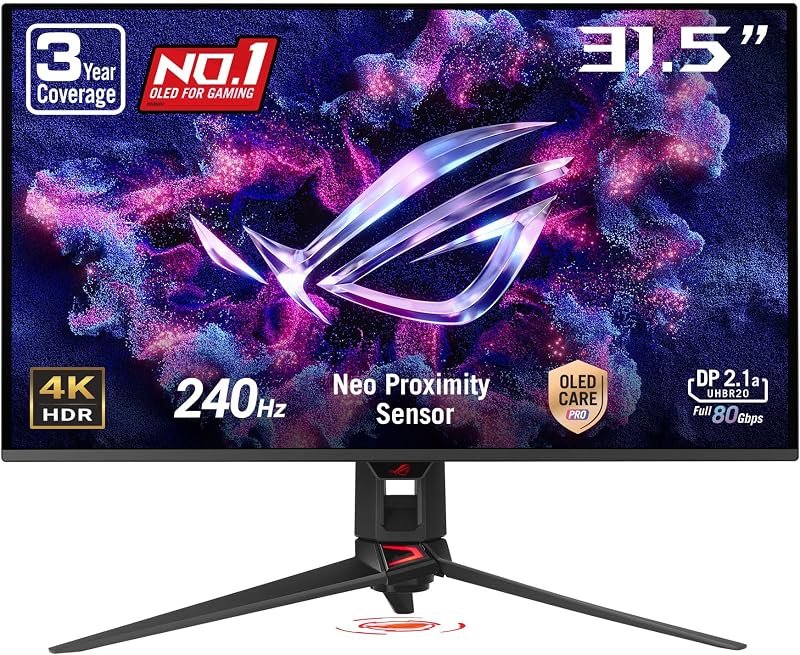
The ASUS ROG PG32UCDMR 32 Inch 4K presents an all-inclusive 31.5-inch package tailored for design professionals and high-fidelity gaming desks. Featuring a third-generation 4K QD-OLED panel with a 240Hz refresh rate and a 0.03ms gray-to-gray response time, the screen delivers blur-free transitions and deep contrast. It includes a matte screen finish that curbs workspace reflections from desk lamps and windows, preserving focus during color-sensitive retouching.
What distinguishes this configuration is its complete out-of-the-box hardware bundle and workflow perks. The packaging supplies a dedicated DisplayPort 2.1 DP80 transmission cable, an Ultra High Speed HDMI cable, USB-C and USB 3.2 data leads, an ROG accessory pouch, and a custom VESA mounting bracket for articulating monitor arms. ASUS also bundles a 3-month subscription to the Adobe Creative Cloud suite, allowing users to immediately deploy the screen’s 99% DCI-P3 gamut and uniform brightness controls in professional editing environments.
The chassis integrates the Neo Proximity Sensor alongside OLED Care Pro features to monitor user presence and prevent panel degradation. Thermal protection is sustained through a fanless custom heatsink. The monitor weighs 19.2 pounds and measures 10.9 inches deep on its stand, meaning users with shallow desk surfaces will benefit from mounting it on a dedicated arm to reclaim workspace.
- DisplayPort 2.1 and 90-watt USB-C connectivity with DP80 cable supplied
- Three-month Adobe Creative Cloud subscription included in the bundle
- Third-generation 4K QD-OLED panel with uniform brightness toggles
- Neo Proximity Sensor and silent passive thermal architecture
05 ASUS ROG PG27UCDM 27 Inch 4K
Best for: High-density desk setups requiring crisp text
Pros
- Ultra-sharp 0.16 millimeter pixel pitch
- DisplayPort 2.1a UHBR20 connectivity
- OLED Anti-Flicker 2.0 comfort
Cons
- Compact 26.5-inch active viewing area
- Requires higher display scaling
For users who prefer sharper pixel density or work on compact desks, the ASUS ROG PG27UCDM 27 Inch 4K scales 3840 x 2160 resolution down to an active 26.5-inch diagonal. This sizing yields a tiny 0.16mm pixel pitch, rendering text, code, and interface fonts with razor-sharp edges that minimize color fringing. Utilizing fourth-generation QD-OLED technology, this display achieves improved longevity over earlier generations while supporting a wide 145% color gamut space.
Desktop comfort is enhanced by OLED Anti-Flicker 2.0 technology. By applying a real-time luminance compensation algorithm, the panel decreases visual flicker by 20% compared to previous generations, alleviating eye fatigue during long desk sessions. For creatives examining an asus oled 27 setup, the display incorporates an integrated top tripod socket designed to mount webcams, lighting arrays, or microphones directly above the frame.
Connectivity options are class-leading, offering DisplayPort 2.1a UHBR20 with full 80Gbps bandwidth, HDMI 2.1, and a 90-watt USB-C port that handles clean mobile docking. The Neo Proximity Sensor handles presence detection, dimming the screen to black when you step away from the desk. It represents a formidable workstation solution where desk depth is limited, though users who favor larger immersion windows will naturally gravitate toward 32-inch alternatives.
- High-density 26.5-inch 4K panel with 0.16mm pixel pitch for crisp text
- DisplayPort 2.1a UHBR20 running uncompressed 80Gbps video feeds
- OLED Anti-Flicker 2.0 reducing luminance fluctuation by 20%
- Integrated webcam tripod socket and 90-watt USB-C power delivery
06 ASUS ROG XG27UCDMG 27 Inch 4K
Best for: Compact gaming desks prioritizing eye comfort
Pros
- 4th-generation Tandem QD-OLED clarity
- OLED Anti-Flicker 2.0 technology
- Custom heatsink thermal design
Cons
- No high-wattage laptop charging listed
- Listing does not specify DP 2.1
The ASUS ROG XG27UCDMG 27 Inch 4K provides a focused, high-density alternative built around fourth-generation Tandem QD-OLED engineering. Spanning a 26.5-inch active area with a 0.16mm pixel pitch, this monitor brings immaculate clarity to complex documents, spreadsheets, and high-framerate action. Operating at 240Hz with an instantaneous 0.03ms response time, the panel delivers blur-free transitions backed by G-SYNC Compatible variable refresh rates.
Comfort and thermal longevity are heavily prioritized in this design. Like its Swift series counterpart, it incorporates OLED Anti-Flicker 2.0 to balance panel luminance during refresh fluctuations, alongside a robust custom heatsink that manages internal temperatures silently. Exploring an asus qd oled 27 display like the XG27UCDMG gives users the benefit of the Neo Proximity Sensor within ASUS OLED Care Pro, which turns off panel illumination when the chair is unoccupied.
Color performance is certified for VESA DisplayHDR 400 True Black, providing true 10-bit color, 99% DCI-P3 coverage, and a Delta E under 2. The listing does not specify high-wattage USB-C power delivery or uncompressed DisplayPort 2.1 bandwidth on this model, which positions it as a dedicated high-performance desktop display for PC towers rather than a laptop docking hub. A complimentary 3-month Adobe Creative Cloud membership is also included to kickstart creative production.
- Fourth-generation 26.5-inch Tandem QD-OLED with 0.16mm pixel pitch
- OLED Anti-Flicker 2.0 luminance compensation for visual comfort
- Neo Proximity Sensor and custom heatsink thermal protection
- VESA DisplayHDR 400 True Black and 3-month Adobe Creative Cloud pass
What Sets These Models Apart
| Model | Panel Technology & Finish | DisplayPort & Video I/O | USB-C Power Delivery | Key Standout Feature |
|---|---|---|---|---|
| ASUS ROG XG32UCWMG 32 Inch 4K | TrueBlack Glossy WOLED | DisplayPort 1.4 (DSC), HDMI 2.1 | 15W Power Delivery | Dual Mode (4K@240Hz / FHD@480Hz) |
| ASUS ROG PG32UCDM 32 Inch 4K | Gen 3 Matte QD-OLED | DisplayPort 1.4 (DSC), HDMI 2.1 | 90W Power Delivery | Dolby Vision and Uniform Brightness |
| ASUS ROG PG32UCDM3 32 Inch 4K | Gen 3 Matte Tandem QD-OLED | DisplayPort 2.1 UHBR20, HDMI 2.1 | 90W Power Delivery | BlackShield Film and DisplayHDR 500 |
| ASUS ROG PG32UCDMR 32 Inch 4K | Gen 3 Matte QD-OLED | DisplayPort 2.1, HDMI 2.1 | 90W Power Delivery | Included DP80 cable and Adobe bundle |
| ASUS ROG PG27UCDM 27 Inch 4K | Gen 4 Matte QD-OLED | DisplayPort 2.1a UHBR20, HDMI 2.1 | 90W Power Delivery | 0.16mm pitch and built-in tripod socket |
| ASUS ROG XG27UCDMG 27 Inch 4K | Gen 4 Matte Tandem QD-OLED | DisplayPort and HDMI (exact spec unspecified) | Listing does not specify | OLED Anti-Flicker 2.0 and compact footprint |
Buying Tips for ASUS 4K OLED Gaming Monitors
When determining which asus rog oled monitor to buy for a shared office and gaming desk, connectivity planning is essential. If you intend to run both a desktop gaming rig and a work laptop, prioritizing a model with 90-watt USB-C power delivery allows you to hook up your notebook with a single cable that carries power, display, and USB data simultaneously. Conversely, if your setup relies solely on a dedicated gaming tower, standard DisplayPort and HDMI configurations will meet your requirements without needing secondary power delivery circuits.
Panel coatings and room lighting should guide your screen surface choice. A glossy panel finish, such as the TrueBlack Glossy WOLED on the XG32UCWMG, maximizes perceived black levels and color pop in light-controlled rooms, but can mirror overhead lights in bright offices. A matte QD-OLED finish effectively diffuses harsh reflections and lamp glare, ensuring uniform visibility across daylight work hours without washing out color saturation.
Finally, factor in desk depth and viewing distance when choosing between 32-inch and 27-inch form factors. A 32-inch screen provides expansive screen real estate for multi-window multitasking, but requires a desk depth of at least 30 inches to view comfortably without excessive head movement. A 27-inch 4K screen boasts a denser 0.16mm pixel pitch that produces exceptionally crisp typography, making it an outstanding fit for shallower work surfaces and heavy text-based workflows.
FAQ
How does the Neo Proximity Sensor protect against panel burn-in?
The Neo Proximity Sensor built into ASUS OLED Care Pro monitors physical presence in front of the display. When you leave your desk for a break or a meeting, the sensor detects your absence and automatically switches the screen to solid black. This stops static operating system elements, window frames, and desktop icons from lingering on the panel, preventing permanent image retention without requiring manual power switching.
Can I power a laptop directly from these ASUS ROG monitors?
Several models in this lineup, including the PG32UCDM, PG32UCDM3, PG32UCDMR, and PG27UCDM, feature a USB-C port equipped with 90-watt power delivery. This provides sufficient wattage to charge and run most modern work notebooks over a single cable while transmitting video and linking USB peripherals. Models like the XG32UCWMG supply 15 watts, which charges phones and low-power accessories but will not support high-draw laptops.
What is the advantage of DisplayPort 2.1 UHBR20 connectivity?
DisplayPort 2.1 with UHBR20 transmission provides up to 80Gbps of total signal bandwidth. This high data rate allows the monitor to receive an uncompressed 4K signal running at a full 240Hz refresh rate with 10-bit color. Earlier DisplayPort 1.4 ports require Display Stream Compression to achieve those frame rates at 4K, which, while visually lossless, requires compression handshakes that some users prefer to avoid.
Why choose a 27-inch 4K OLED over a 32-inch model for desk work?
A 27-inch 4K screen yields a tighter pixel pitch of 0.16mm compared to 0.18mm on a 32-inch display. This higher density delivers visibly crisper character rendering and smoother lines, which is particularly beneficial for software developers, writers, and editors who stare at fine typography for hours. Additionally, 27-inch panels fit comfortably on compact desks where a 32-inch monitor would sit too close to the user’s field of view.
What does OLED Anti-Flicker 2.0 do during daily computing?
OLED panels can exhibit subtle brightness variations when variable refresh rates fluctuate rapidly during demanding tasks or loading transitions. OLED Anti-Flicker 2.0 uses a specialized luminance compensation algorithm that levels out these shifts, cutting perceivable flicker by 20% compared to previous panel iterations to create a steadier, more comfortable visual environment over long work sessions.
Pairing an ultra-fast OLED monitor with proper ergonomics ensures long gaming sessions remain comfortable and immersive. Once your display placement, refresh rates, and cable routing are dialed in, our Gaming Chair Guide outlines how to optimize seating posture to match high-end screen heights. Together, these adjustments create a balanced workspace that maximizes visual clarity while reducing physical fatigue throughout the day.